


5 Statistics That Show Why Relationship Counsellors are Needed More Than Ever
Australians are still marrying in large numbers, and still separating in large numbers. What the data makes clear is that relationship breakdown rarely happens early, and that most people struggling with a relationship never speak to a professional about it.
The latest ABS figures show divorces rising again, with the typical marriage running close to a decade before separation. Meanwhile, Australian research found only around one in five people with relationship problems sought professional help, and the older evidence we do have on marriage counselling outcomes is broadly positive.
This article walks through what those numbers show, what they leave out, what couples say they actually want from counselling, and what the work asks of a practitioner who wants to specialise in it.
Five quick facts
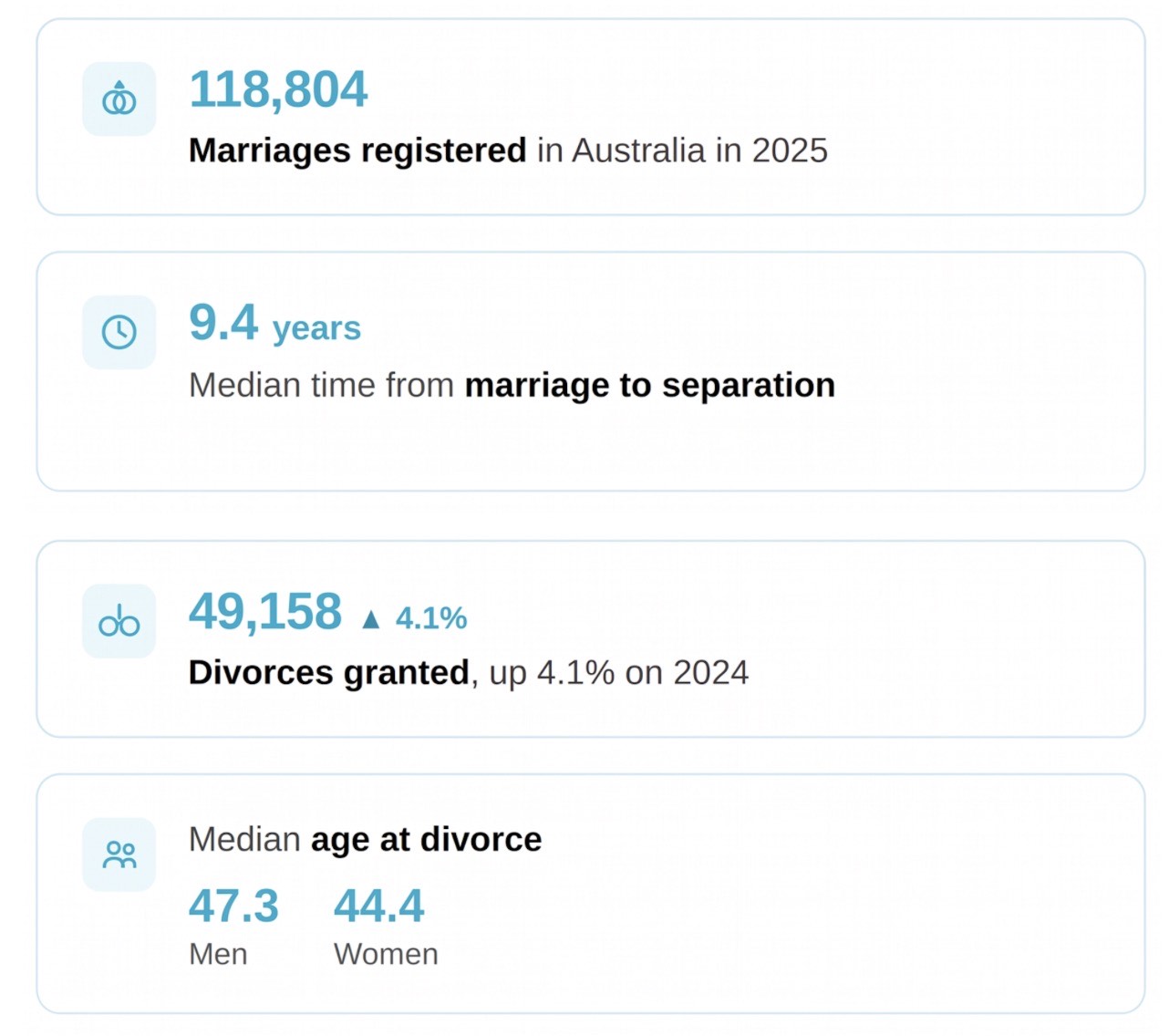
- Divorce is trending up. 49,158 divorces were granted in 2025, a 4.1% rise on the year before, with the crude divorce rate lifting from 2.1 to 2.2 per 1,000 Australians aged 16 and over.
- Marriage is still popular. 118,804 marriages were registered in 2025, so this isn’t a story about Australians giving up on long-term commitment.
- Trouble surfaces years in, not early. The median time from marriage to separation was 9.4 years, and the median age at divorce was 47.3 for men and 44.4 for women.
- Most people never ask a professional. In one Australian study of 1,204 adults, only 22% sought professional help for relationship problems. Friends, family and their partner came first.
- The outcomes evidence is encouraging. Among couples who entered counselling while still together, 78% of women and 83% of men reported improvement, and more than 80% would recommend counselling to others. Note this is older Australian research.
Ask people to name the most important things in their life and relationships come up early. Ask whether those relationships are simple and you’ll get a very different answer.
Even good ones go through rough patches. Jobs change, children arrive, money gets tight, someone’s parent gets sick, and the way two people talk to each other slowly shifts without either of them really noticing. Plenty of couples work through all of that on their own. Others get stuck, and that’s usually where professional support starts to matter.
If you’re already counselling, or you’ve been weighing up whether relationship work might suit you, the Australian data is worth a proper look. Marriage is still very much alive here. So is relationship breakdown. And a surprising number of people who are struggling never speak to anyone qualified about it.
So what do the numbers actually say?
What do the statistics demonstrate for the demand for couples counsellors?
Figures like these flatten things out, obviously. Every one of those divorces involved two people, often children, and years of shared history being untangled. But they do tell us something useful about where the need sits, and about how few people are reaching for support when things start to go wrong.
Nearly 50,000 marriages ended in divorce in one year
There were 49,158 divorces granted in Australia in 2025, up from 47,216 the year before. The crude divorce rate also ticked up, from 2.1 to 2.2 divorces per 1,000 Australians aged 16 and over.
Divorce data has obvious limits, though. It only counts marriages, and only the ones that made it all the way through the legal process. It says nothing about the de facto couple who separated last winter, or the pair who had a genuinely awful year and came out the other side, or the couple who split up amicably and still co-parent well.
Relationship counselling sits across that whole spectrum. Some of the work is about repair. Some is about helping people communicate without the same argument surfacing every fortnight. Some is about supporting two people through a separation they’ve already decided on, so it happens with less damage to them and to their kids.
Trouble often shows up years in
One statistic worth sitting with is the 9.4-year median from marriage to separation. Divorce takes longer again, partly because Australia requires 12 months of separation before an application can be made.
Nearly a decade. That’s not a couple who rushed into something and realised their mistake by the second anniversary.
It’s a useful corrective to the idea that struggling relationships were somehow flawed from the start. A relationship can work perfectly well for years and then be tested by something entirely new: a baby, a promotion, a redundancy, a diagnosis, ageing parents, grief, or one person changing in ways the other didn’t expect. Sometimes it’s just a decade of small things nobody ever said out loud.
For a counsellor, that means the issue a couple names in the first session is rarely the whole picture. It’s the door in.
Most people never ask for help
This is the finding that tends to stop counsellors in their tracks.
Research reviewed by the Australian Institute of Family Studies looked at an Australian study of 1,204 adults and found that just 22 per cent sought professional help when they were having relationship problems. Most talked to friends, to their partner, or to family instead.
There are plenty of reasons people hesitate. Some don’t think their problems are serious enough to justify it. Some are worried about the cost, or what other people would think, or what might come up in the room once they start talking. And a fair few simply have no clear idea what relationship counselling actually involves, beyond what they’ve seen on television.
Which is worth pushing back on, because it feeds an outdated assumption: that counselling is for relationships already in trouble.
You don’t have to be on the brink to book a session. A lot of the most useful work happens well before that point, when two people are still fundamentally okay but have noticed a pattern they don’t like.
Does couples counselling actually work?
There’s no single success rate for couples counselling, and honestly, there shouldn’t be. Couples arrive with different goals, different histories and very different definitions of a good outcome. Staying together isn’t always the one they want.
That said, Australian research into marriage counselling did find encouraging results. Among couples who came into counselling while still together, 78 per cent of women and 83 per cent of men said the problems they’d sought help for had changed for the better. Across the wider group studied, roughly two-thirds felt counselling had contributed to resolving their problems, and more than 80 per cent said they’d recommend it to someone else.
Worth flagging: this is older Australian research, and practice has moved on a good deal since. Treat the figures as indicative rather than current. Still, the underlying point holds up.
A good outcome might be rebuilding connection. It might be getting through a disagreement without it escalating into the same fight they’ve been having for three years. It might be one partner finally understanding something about the other that had never landed before. And sometimes it’s two people making a hard decision with more clarity and more respect than they’d have managed alone.
What couples say they want
Australian research has also asked people what they’re actually after when they walk in. It’s less about wanting a verdict on whether to stay together than you might assume.
What they reported wanting was help to:
- communicate more effectively
- handle conflict
- understand their relationship
- understand their own part in the difficulties
- see things from their partner’s perspective
- build healthier interpersonal skills
- feel emotionally supported
None of that is exotic. It’s ordinary human stuff, which is exactly why it’s hard to do well.
It also explains why relationship counselling asks more of a practitioner than knowing a framework. You’re tracking two people at once, watching what happens between them rather than just within each of them, holding your own neutrality, and creating enough safety that two different versions of the same story can be said out loud in the same room. Taking sides is the easiest mistake in the work, and often the most tempting one.
What could impact relationships
What’s happening around a couple shapes what happens between them. Financial pressure, work stress, parenting load, isolation and mental health all leak into the relationship.
The ABS reported that 17.3 per cent of Australians saw a health professional for their own mental health in 2024–25. Access is still patchy, though. Among those who needed to see someone, 34.4 per cent delayed or didn’t go on at least one occasion when they needed to, and 19.7 per cent named cost as a reason.
Mental health treatment and relationship counselling are separate areas of practice, and it’s important not to blur them. But they do intersect constantly. Understanding a client usually means understanding the pressures and relationships surrounding them as well.
It’s not just couples in crisis
The stereotype is two people at opposite ends of a couch, arms folded, making one last attempt to save a marriage.
Real relationship work is broader than that. Counsellors support people through:
Communication difficulties. Helping clients see how they listen, react, withdraw, criticise or shut down, often without realising they’re doing it.
Conflict. Working out what’s actually underneath a recurring argument, which is almost never the thing being argued about.
Life transitions. Parenthood, blended families, career changes, relocation, ageing, retirement.
Intimacy and connection. Emotional distance, trust, vulnerability, and the slow drift that neither person decided on.
Separation and divorce. Supporting one or both people through the emotional reality of an ending, including how to keep co-parenting workable.
Family relationships. The wider system a couple sits inside, which usually has more influence than either partner thinks.
The job isn’t to have the right answer. It’s to help two people work out what’s happening between them.
The skills the work actually demands
Relationship counselling asks for a specific combination of clinical knowledge and personal capability.
You need to hear what isn’t being said as much as what is. You need enough emotional steadiness to sit with strong feelings without becoming part of the conflict yourself, which is harder than it sounds when a room gets hot. You need to spot patterns rather than getting drawn into adjudicating individual arguments. And you need to build a space where two people who disagree can both be heard without it turning into a scoring exercise.
Those skills develop with training and supervision. They’re not something you either have or don’t.
Is relationship work your next step?
Some counsellors are clear that individual work is where they want to stay, and that’s a perfectly good career.
Others find their curiosity keeps drifting to what happens between people, rather than within them. If that’s you, specialising is worth thinking about seriously. Relationship counselling covers couples, families and individuals working through relationship difficulties, from communication and conflict through to separation, family transitions and shifting dynamics over time.
At IAP, the CHC81015 Graduate Diploma of Relationship Counselling is built for qualified counsellors and eligible professionals who want to develop that specialist capability properly.
Because when two people, two perspectives and years of shared history walk into a room together, knowing the framework is only part of the job. Learning to apply it under those conditions is where the specialist work really starts.
| If you are ready to become a specialisations relationship counsellor, download the brochure here or call us on 1300 915 497 to talk about your options of becoming a Relationship Counsellor. |
FAQ
How many divorces were there in Australia in 2025? The ABS recorded 49,158 divorces granted in 2025, up 4.1% from 47,216 in 2024. The crude divorce rate rose from 2.1 to 2.2 per 1,000 Australians aged 16 and over.
How long do marriages last before separation in Australia? The median time from marriage to separation was 9.4 years in 2025. Median duration to divorce is longer again, because Australia requires 12 months of separation before a divorce application can be made.
Does couples counselling actually work? Australian research into marriage counselling found that among couples who entered counselling while still together, 78% of women and 83% of men reported the problems they sought help for had improved. Around two-thirds felt counselling contributed to resolving their problems, and more than 80% would recommend it. This is older research, and outcomes vary depending on the couple and their goals.
How many people seek professional help for relationship problems? In an Australian study of 1,204 adults reviewed by AIFS, only 22% sought professional help when experiencing relationship difficulties. Most spoke with friends, their partner or family instead.
What qualification do you need to become a relationship counsellor in Australia? The CHC81015 Graduate Diploma of Relationship Counselling is a nationally accredited AQF Level 8 qualification for counsellors, psychologists, social workers and equivalent practitioners who want to specialise in couples and family work. The CHC51015 Diploma of Counselling is the usual prerequisite pathway.