


Is a BSB50120 Diploma of Business Worth It in 2026? Career Outcomes, Salaries and What Employers Actually Want
Overview
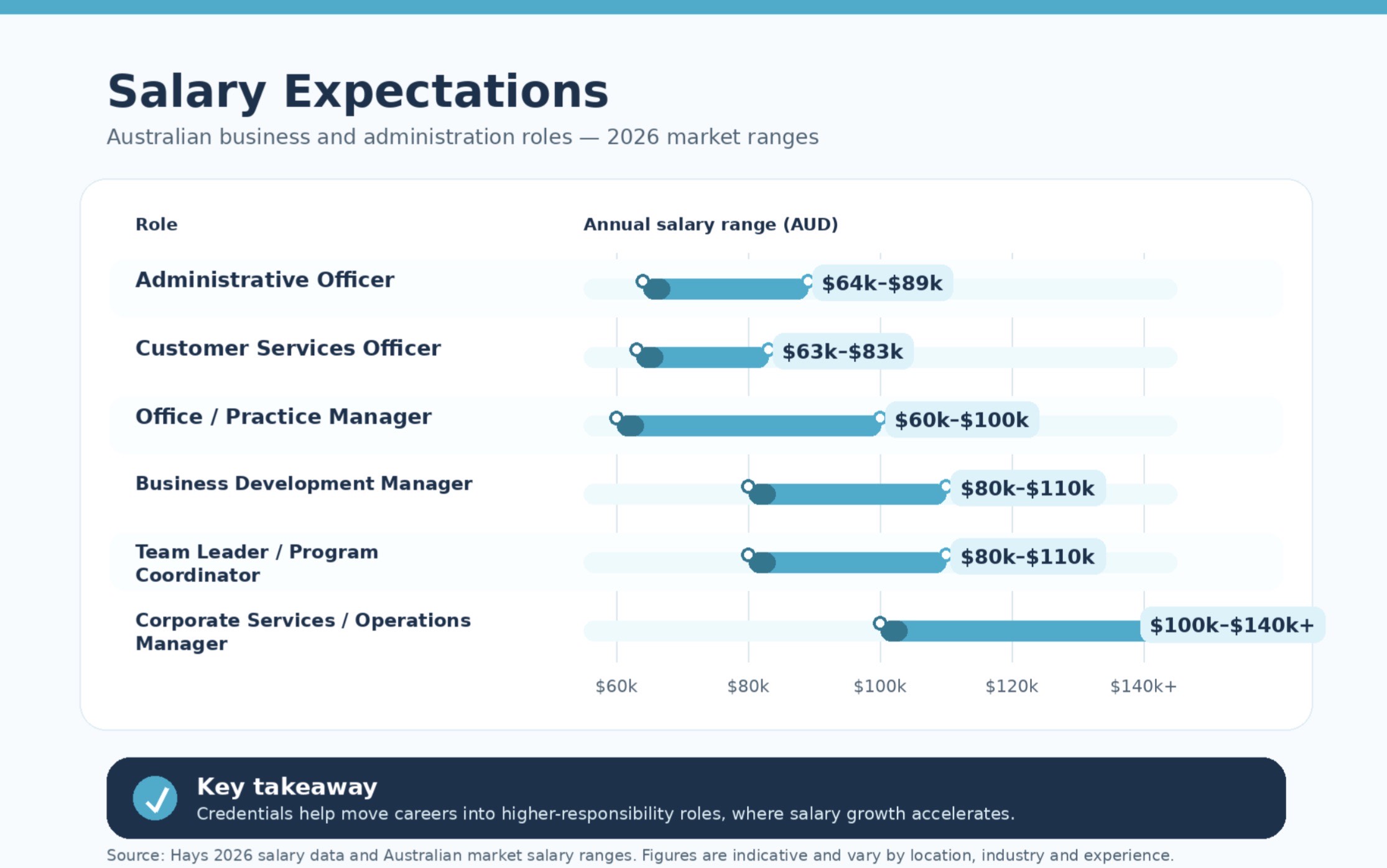
Yes, a BSB50120 Diploma of Business is worth it in 2026 for most Australians seeking business, management or administrative roles. VET graduates record a median income uplift of $14,100 after completing their qualification, 88% move into employment post-qualification, and 89% are satisfied with their training. The diploma leads to roles such as Office Manager ($75K–$100K), Team Leader ($80K–$110K), and Corporate Services Manager ($100K–$140K+). It also serves as a direct pathway into bachelor’s degree programs with credit transfer at most Australian universities. The qualification is nationally recognised, practically focused and designed for working professionals.
Key Takeaways
- VET graduates record a median income uplift of $14,100 after completing their qualification (Jobs and Skills Australia), with 88% moving into employment post-qualification. ROI can be achieved within 3–7 months of completion.
- Career outcomes range from $63K (entry-level admin) to $140K+ (senior operations management), with demand for business management roles projected to grow by 9.1% through 2026.
- Most Australian universities offer guaranteed entry and credit transfer for diploma graduates, with up to 8 units of credit toward a bachelor’s degree, meaning you can enter the second year of a degree program.
- 89% of VET qualification completers are satisfied with their training and 87% achieve their main training goal, making VET one of the highest-satisfaction education pathways in Australia.
- Over 70% of employers prioritise soft skills (communication, emotional intelligence, critical thinking) over technical skills when evaluating candidates. The Diploma of Business builds these through assessed competencies, not theory alone.
If you are weighing up whether a BSB50120 Diploma of Business is worth your time and money in 2026, you are asking exactly the right question. Education is an investment, and like any investment, the value depends on the return.
This article gives you a clear, evidence-based answer. We will look at what the qualification covers, what career outcomes it leads to, what salaries you can expect, what the national data says about VET graduate outcomes, how employers view it and whether it stacks up against other options.
What a BSB50120 Diploma of Business Actually Covers
The BSB50120 Diploma of Business is a nationally recognised AQF Level 5 qualification designed for people starting in or moving into business roles that involve moderately complex tasks and aim for front-line management responsibilities. It typically includes five core units and seven elective units.
Core competencies include critical thinking, emotional intelligence, problem-solving, business communication, project management fundamentals, operational planning, and continuous improvement. Coaching plays a huge role, too!
The practical focus is deliberate. Unlike a traditional university degree, which is built around theoretical frameworks and academic research, the diploma is designed around workplace application. You learn how businesses function, how projects are managed, how teams are led and how operations are improved, and you apply that learning to real scenarios throughout the program.
If you want to learn what some of the most successful people in business do, this diploma could be for you.
Graduate Outcomes
Before looking at specific career outcomes, it is worth examining the national evidence on whether VET qualifications deliver a return on investment. The answer, based on the most recent data, is unequivocally yes.
Jobs and Skills Australia’s latest data show that VET graduates record a median income uplift of $14,100 after completing their qualification, up from $11,800 in the previous cohort. That represents an approximately 20 per cent year-on-year increase in the premium the labour market places on formalised VET skills. JSA described this finding as showing that VET graduates are getting “exceptional gains” from their qualifications, with 88 per cent of graduates now moving into employment post-qualification.
The NCVER 2024 VET Student Outcomes report found that 64.4 per cent of qualification completers improved their employment status after training. 87.4 per cent achieved their main training goal and 89.5 per cent were satisfied with their training. A third went on to further study, confirming the diploma’s role as both a standalone qualification and a stepping stone.NCVER 2024 VET Student Outcomes report found that 64.4 per cent of qualification completers improved their employment status after training. 87.4 per cent achieved their main training goal, and 89.5 per cent were satisfied with their training.
Example: Consider someone earning $55,000 in an administrative support role. After completing a BSB50120 Diploma of Business, they could move into an office manager position at $82,000. That is a $27,000 annual increase. If the diploma cost $10,000, the investment paid for itself before the end of the fifth month.
What Roles Could You Do?
Graduates of the diploma are equipped for a range of entry-level and mid-level management positions. Common career outcomes include Executive Officer, Office Manager, Business Sales Team Leader, Administrator, Corporate Services Manager, Team Leader, Unit Leader, Administration Manager and Program Coordinator.
These roles exist across virtually every industry, including healthcare, professional services, education, construction, government, retail and not-for-profit. The breadth of application is one of the diploma’s greatest strengths. You are not locked into a single sector. You are qualified for a function, business management, that every sector needs.
The National Skills Commission projects that Professionals and Community and Personal Service Workers will account for nearly 60 per cent of total job growth, adding close to 700,000 new roles. Business management sits squarely in this growth trajectory.
Salary Expectations
Salaries vary by role, location, industry and experience, but Australian market data for 2026 suggests the following ranges:
How Employers View the Diploma of Business
Employers care about three things: can you do the job, do you have evidence of capability and will you continue to grow. A nationally recognised diploma addresses all three.
Deloitte’s research shows that over 70 per cent of organisations now prioritise soft skills, including communication, emotional intelligence and critical thinking, over technical skills when evaluating candidates. The Diploma of Business builds these capabilities through assessed competencies rather than theory alone. You do not just learn about project management. You demonstrate it. You do not just study communication. You are assessed on it.
The qualification also signals commitment to professional development, which matters in a market where employers are increasingly investing in upskilling existing staff rather than hiring externally. A diploma on your resume tells an employer you take your career seriously enough to invest in it.
Diploma vs. Degree: How Does It Compare?
A Diploma of Business and a Bachelor of Business are not competing qualifications. They serve different purposes at different stages of a career.
A diploma is faster and more focused. It typically takes 12 to 18 months, covers practical business skills and gets you into the workforce or a promotion sooner. It is AQF Level 5 and designed for those new to business, frontline management and operational business roles.
A degree is broader and deeper. It takes three to four years, covers theoretical foundations and often includes specialisation options. It is AQF Level 7, designed for professional and strategic roles.
They stack together. Most Australian universities offer RPL entry and credit transfer for diploma graduates. This means you can start with a diploma, enter the workforce, and continue to a degree later if you choose, without losing time or money.
Is It Worth It for You?
A BSB50120 Diploma of Business is worth it if you are in one or more of the following situations:
- You want to move into a business role but lack formal qualifications.
- You are already working in business and want to formalise your experience.
- You want a pathway to a degree without committing to three or four years of study upfront.
- You are changing careers and need a qualification that is relevant across industries.
- You want to start your own business.
What to Look for in a Provider
Not all diploma programs are created equal. The qualification code (BSB50120) is standardised, but the quality of delivery, student support and learning experience and coaching inclusion varies significantly between providers. When choosing, look for:
- Nationally recognised training under the BSB50120 qualification code, delivered by a registered training organisation (RTO).
- Experienced facilitators with real industry backgrounds, not just academic credentials.
- Flexible online delivery that fits around your existing work and personal commitments.
- Strong student support, including access to facilitators, learning resources and pastoral care.
- A clear pathway to further study or RPL options for those with relevant workplace experience.
- 1:1 Coaching and mentoring opportunities included
IAP’s BSB50120 Diploma of Business is not a standard diploma. It includes real-world case studies, 1:1 coaching and mentoring. It is built like a mini MBA and provides the structure, guidance, and real-world skills that someone stepping into business typically needs. It is delivered entirely online, facilitated by senior, experienced Australian practitioners, and designed for working professionals seeking practical, applicable skills. The program also offers Recognition of Prior Learning for those with relevant workplace experience and who seek to back themselves. With 89 per cent of VET students satisfied with their training nationally, the VET pathway has never been stronger.
To find out whether a BSB50120 Diploma of Business is the right next step for you, call 1300 915 497 or visit iap.edu.au to speak with an education advisor.