


Strategic Psychotherapy & Ericksonian Hypnosis Career Guide
If you are seriously considering a career in clinical hypnotherapy, you have probably noticed that the training landscape is crowded. Dozens of providers, each claiming to be the best. But beneath the marketing sits a question most prospective students never think to ask: what therapeutic framework will you actually learn to use?
You could learn how to hypnotise your client, but then what? What words do you say, what tools do you use, how do you create lasting change? That’s the difference between learning hypnosis and training to become a therapist, including strategic psychotherapy.
This matters because hypnosis, on its own, is not a therapy. It is a state of focused attention. It is the vehicle, not the destination. What determines outcomes is what happens inside that state, and that is shaped by the strategic psychotherapy model the practitioner has been trained in, and whether they deliver it through flexible Ericksonian hypnosis or rigid, pre-written scripts.
This guide, written by Gordon Young, Dip Clin Hyp & Strat Psych, BA (Hons), Dip Ed, founder of the Institute of Applied Psychology (IAP) and creator of the Gordian Pillars of Psychotherapy, answers three questions every serious prospective hypnotherapist asks but rarely finds answered in one place.
Key Takeaways
✓ Strategic psychotherapy focuses on what is maintaining a problem right now, not on its historical origins. It tells the practitioner what to do with hypnosis once the client is in a focused state.
✓ Ericksonian (non-script) hypnosis adapts to each client in real time. A 2026 meta-analysis of RCTs found it produces large effect sizes, matching or outperforming established psychotherapies.
✓ The Gordian Pillars map the specific cognitive distortions maintaining conditions like anxiety, phobias, and insomnia, giving practitioners a diagnostic framework from day one.
✓ A 2024 Frontiers in Psychology mega-review of 49 meta-analyses and 261 primary studies found over 54% of reported effect sizes for clinical hypnosis were medium or large (Cohen’s d ≥ 0.5).
✓ A clinical hypnotherapist’s typical day involves 3–5 client sessions, case planning, admin, professional development, and self-care, with significant control over schedule and work environment.
What Is Strategic Psychotherapy?
Strategic psychotherapy is a therapeutic approach that identifies the specific cognitive and behavioural patterns maintaining a client’s problem and intervenes to interrupt them, rather than spending extended time exploring the problem’s historical origins. It is the framework that tells a clinical hypnotherapist what to do with hypnosis once the client is in a focused state.
Where traditional therapy might spend months asking “why do you feel this way?” and tracing the problem back through decades of personal history, strategic psychotherapy asks a different question: what is keeping this problem alive right now, and how do we interrupt that pattern?
This is not a minor philosophical difference. It changes the speed, direction, and effectiveness of treatment.
The Gordian Pillars: A Diagnostic Map for Practitioners
One of the challenges new therapists face is walking into a session with a client and not knowing where to start. The client presents with anxiety, insomnia, a phobia, or a habit they cannot break. The therapist knows how to induce hypnosis. But what do they actually do once the client is in a focused state?
This is the problem the Gordian Pillars of Psychotherapy were designed to solve. Developed by Gordon Young at the Institute of Applied Psychology, the Gordian Pillars map the specific, predictable cognitive distortions that underpin common psychological conditions. There are Gordian Pillars for anxiety, depression, addiction, phobias, grief, OCD, chronic pain, insomnia, and more.
Each pillar identifies the core cognitive mechanism sustaining the condition. Here are three examples of how the framework operates in practice.
Anxiety: The Gordian Pillars identify catastrophic projection as the maintaining mechanism. The person’s mind jumps from a minor concern to a worst-case outcome in seconds, triggering a fight-or-flight response. The strategic intervention targets the projection pattern, not the anxiety symptom.
Phobias: The maintaining mechanism is avoidance behaviour. The person avoids the feared stimulus, which prevents the brain from updating its threat model. The strategic intervention interrupts the avoidance cycle, allowing the brain to recalibrate.
Perfectionism and insomnia: Perfectionism is maintained by counterfactual rumination, replaying events through impossibly high standards. At bedtime, this pattern runs unchecked because there are no distractions. The strategic intervention targets the rumination pattern, and the sleep improvement follows naturally.
For a new practitioner, this is transformative. Instead of sitting across from a client feeling uncertain about where to begin, the Gordian Pillars give you a structured diagnostic framework. You identify which cognitive distortion is active, and that tells you what intervention to deliver through hypnosis.
Dr William Herfel of the University of Newcastle has described Strategic Psychotherapy and the Gordian Pillars as “a major advancement beyond CBT and ACT, and potentially the next big thing in psychotherapy.”
How Does Strategic Psychotherapy Compare to CBT and Other Approaches?
If you come from a background in psychology, counselling, or allied health, you will want to know how strategic psychotherapy fits alongside the modalities you already know. The following comparison highlights the key differences.
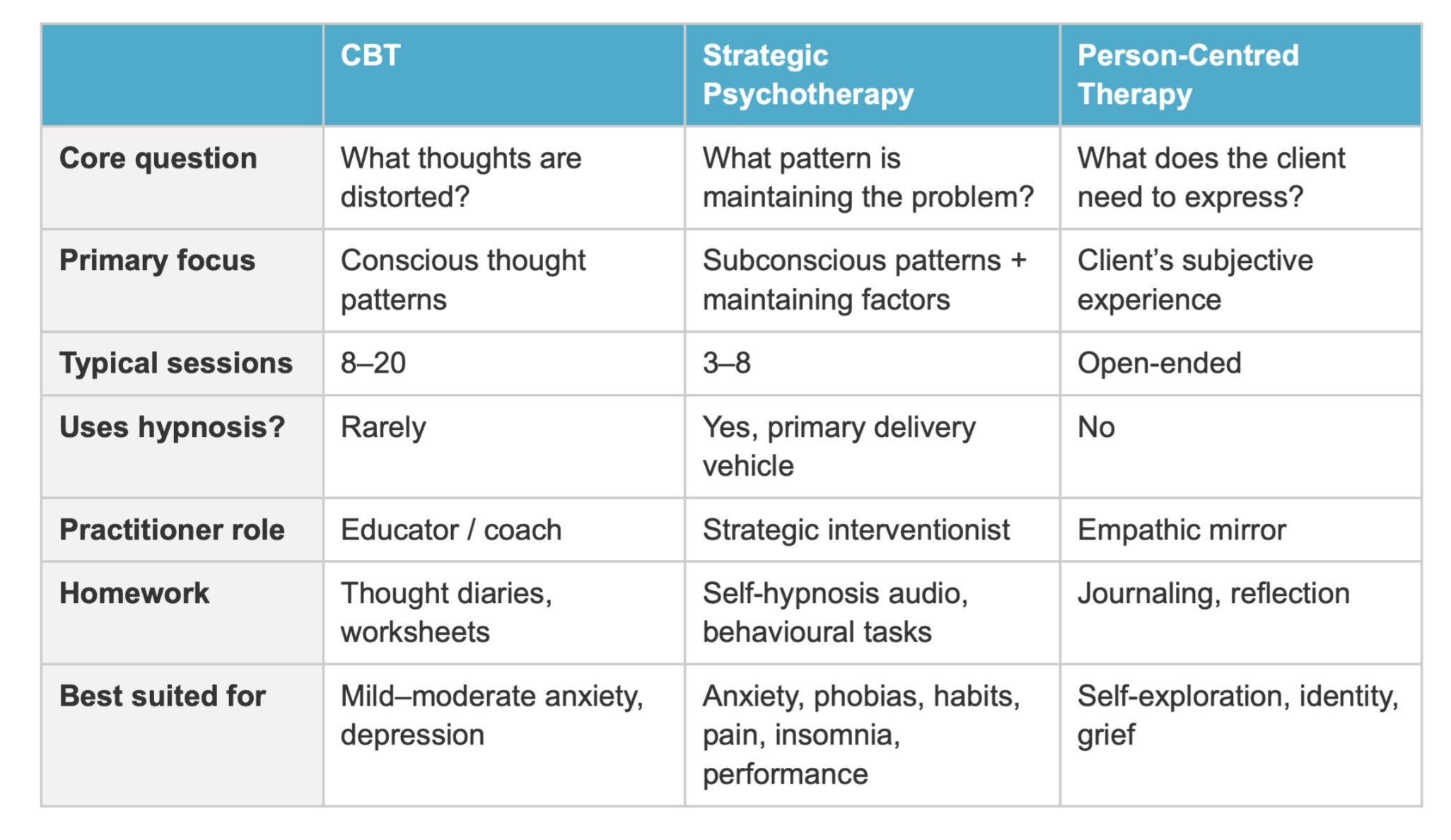
These approaches are not necessarily in competition. Many effective practitioners draw from multiple frameworks. But strategic psychotherapy, delivered through clinical hypnosis, offers something distinctive: speed and precision. Because it targets the maintaining mechanism directly, and because hypnosis operates at the subconscious level where those mechanisms live, the typical course of treatment is shorter and the results tend to be more durable.
Ericksonian Hypnosis vs Script-Based Hypnosis: Why the Approach You Learn Matters
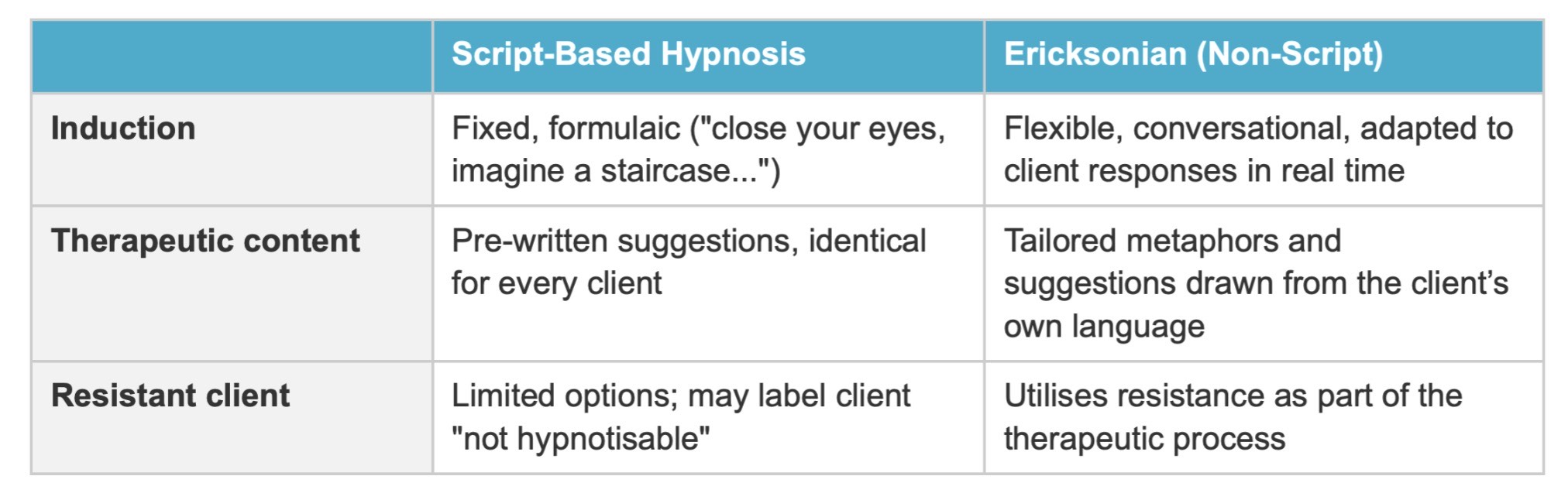
If strategic psychotherapy is the “what” of clinical hypnosis (the therapeutic framework), then the style of hypnosis you learn is the “how” (the delivery method). And the difference between Ericksonian hypnosis and traditional script-based hypnosis is one of the most important distinctions in the field.
What is Ericksonian hypnosis?
Ericksonian hypnosis is a flexible, client-centred approach to therapeutic hypnosis, named after the psychiatrist Milton H. Erickson, that adapts to each individual in real time rather than following a pre-written script. The practitioner uses the client’s own language, metaphors, experiences, and responses to guide the therapeutic process. It is the approach taught in most advanced clinical training programs worldwide.
Erickson believed that every person’s subconscious mind already contains the resources needed for change. The practitioner’s job is not to impose a solution from the outside (as a script does) but to create conditions in which the client’s own mind can reorganise itself toward health.
What is script-based hypnosis?
Script-based hypnosis is exactly what it sounds like. The practitioner reads or recites a pre-written script during the session. There are scripts for smoking cessation, scripts for weight loss, scripts for confidence, scripts for anxiety. The same words are delivered to every client, regardless of their individual circumstances, personality, or the specific factors driving their problem.
Analogy: Script-based hypnosis is like reading a recipe word for word. It does not matter what ingredients you have in your kitchen, what your dietary needs are, or what you actually enjoy eating. You follow the recipe. Ericksonian hypnosis is like being a skilled chef who can walk into any kitchen, assess what is available, and create something excellent from what is there. The chef understands principles deeply enough to adapt. The recipe reader is stuck when the ingredients change.
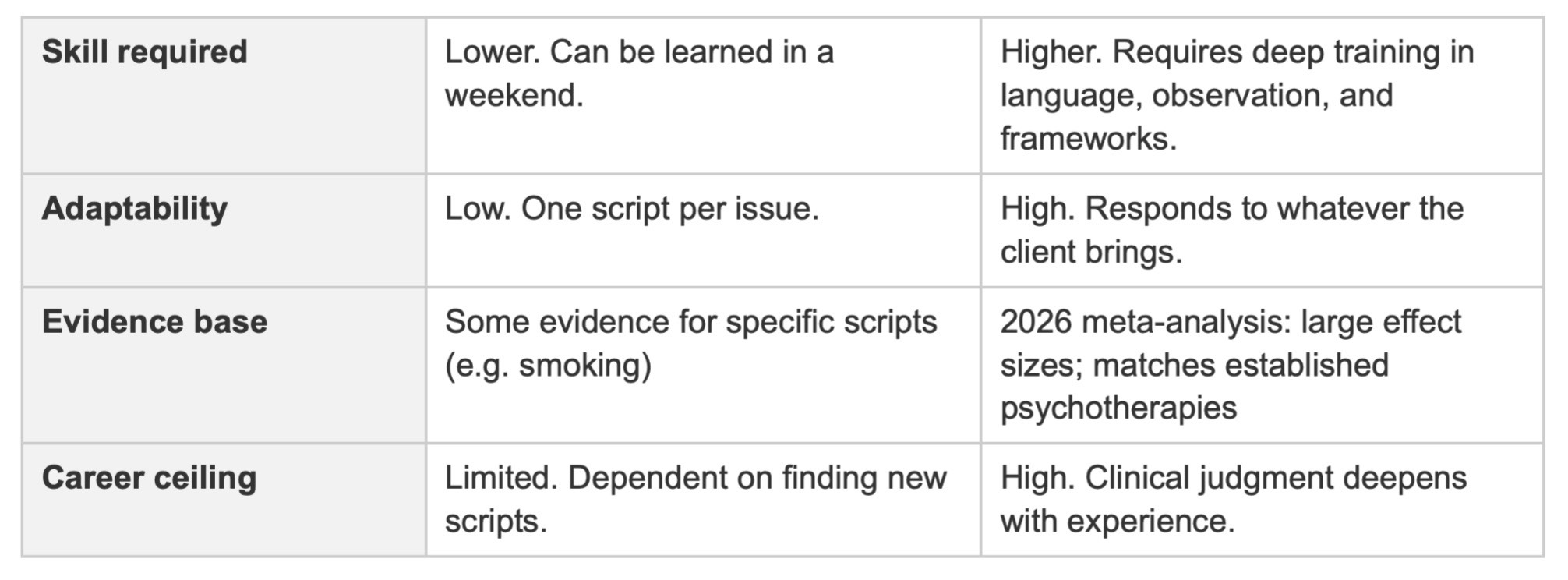
The following comparison shows why this distinction shapes the ceiling of your clinical capability and your long-term career.
What Does the Research Say? The Evidence for Clinical Hypnosis
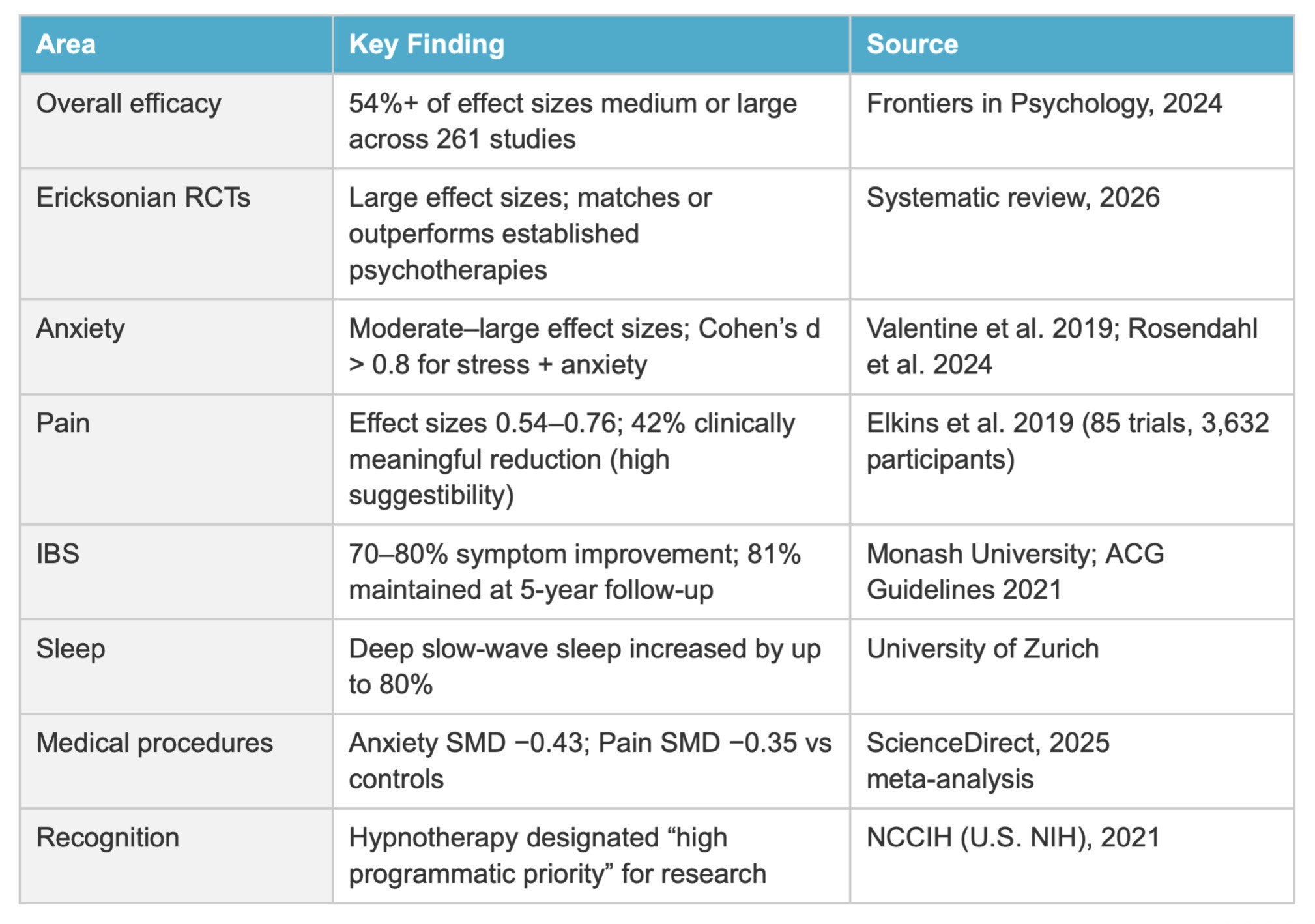
The evidence base for clinical hypnosis has moved well beyond anecdote. Here are the key findings from recent peer-reviewed research.
261 studies, 49 meta-analyses. A 2024 mega-review published in Frontiers in Psychology analysed 49 meta-analyses encompassing 261 distinct primary studies on clinical hypnosis. Over 54% of reported effect sizes were medium (Cohen’s d ≥ 0.5) or large (d ≥ 0.8), with effect sizes ranging from d = 0.04 to d = 2.72 across conditions (Rosendahl et al., Frontiers in Psychology, 2024).
Ericksonian hypnotherapy specifically. A 2026 systematic review and meta-analysis of randomised controlled trials examining Ericksonian hypnotherapy found large effect sizes compared to minimal interventions (standard care, psychoeducation, or supportive communication). The review concluded that Ericksonian hypnotherapy can match or slightly outperform established psychotherapies in certain contexts (ResearchGate, 2026).
Anxiety. A meta-analysis by Valentine et al. (2019) demonstrated moderate-to-large effect sizes for hypnosis in anxiety reduction. A separate study found hypnotherapy produced stress reduction with Cohen’s d > 0.8 (large effect) and anxiety reduction with Cohen’s d > 0.8 in psychiatric patients (Rosendahl et al., 2024).
Pain management. A 2019 meta-analysis of 85 controlled trials involving 3,632 participants found analgesic effect sizes of 0.54 to 0.76 for hypnosis across all pain outcomes. For highly suggestible clients, clinically meaningful pain reductions reached 42% (Elkins et al., 2019).
National research priority. In 2021, the U.S. National Center for Complementary and Integrative Health (NCCIH), part of the National Institutes of Health, designated hypnotherapy as a “high programmatic priority” for research funding, recognising evidence for its efficacy in IBS, chronic pain, PTSD, and other conditions (NCCIH, 2021).
Ready to explore training? The 11271NAT Diploma of Clinical Hypnosis and Strategic Psychotherapy is the only government-accredited qualification in Australia teaching non-script Neo-Ericksonian hypnosis, strategic psychotherapy, and the Gordian Pillars framework. Call 1300 915 497 or download the course brochure.
What Does a Clinical Hypnotherapist Actually Do All Day?
You now understand the therapeutic framework (strategic psychotherapy) and the delivery method (Ericksonian hypnosis). But what does the actual work look like, hour by hour, on a typical day?
The following schedule reflects a clinical hypnotherapist in private practice seeing four clients, which is a sustainable full-time load. Some practitioners see three. Some see five. The structure adapts to fit your lifestyle, which is one of the profession’s greatest appeals.
Before the day begins: preparation
The night before, or early that morning, the practitioner reviews client notes for the day. For each client, they revisit the Gordian Pillars assessment and check where the client is in their treatment arc.
- New client: Review the intake form, note presenting issues, formulate initial hypotheses about which cognitive distortions might be active.
- Returning client: Review notes from the previous session, check what self-hypnosis practice was assigned, plan the session focus based on progress.
This preparation typically takes 10–15 minutes per client. It means you walk into each session with a clear plan rather than improvising.
The day, hour by hour
7:30 AM Morning routine
Many practitioners start the day with their own self-care practice: exercise, meditation, or a brief self-hypnosis session. Working with clients’ emotional material all day requires you to be grounded, present, and emotionally regulated. The airline analogy applies: put on your own oxygen mask first.
8:30 AM Workspace setup and client review
Whether you work from a dedicated clinic room, a home office, or via telehealth, you prepare the space. Handle quick admin: booking enquiries, appointment confirmations, invoices.
9:00 AM Client 1 – New client assessment
10:15 AM Break and case notes
Session notes (required for ethical practice and association membership), Gordian Pillars assessment recorded, treatment plan outlined. A 15-minute reset between clients is standard.
10:30 AM Client 2 – Session 4 of 6 (habit change)
11:45 AM Break and admin
Case notes for Mark. Check email, respond to new enquiries. Review the afternoon schedule.
1:00 PM Professional development or marketing your clinic
Successful practitioners dedicate at least one block per week to practice-building activities: writing educational content (credibility + referrals), attending online supervision or peer consultation (a professional association requirement), completing CPD training, or building referral relationships with GPs, psychologists, and allied health professionals.
2:00 PM Client 3 – Session 2 of 6 (performance anxiety)
3:15 PM Break and case notes
Notes for James. Review progress against treatment plan. Identify the focus for session three.
3:30 PM Client 4 – Session 3 of 5 (chronic pain).
4:45 PM End-of-day admin and close
Final case notes. Update the booking system. Send follow-up resources to clients (self-hypnosis recordings, psychoeducation material). Review tomorrow’s schedule and begin preparation.
What this day reveals
- Variety. Anxiety, habit change, performance, pain. No two sessions are the same. The work is intellectually engaging and never repetitive.
- Depth. The practitioner is not reading scripts. They are using a sophisticated framework (the Gordian Pillars) combined with a flexible method (Ericksonian hypnosis) to deliver precise, personalised interventions.
- Autonomy. You control your schedule, client load, fees, and work environment. Four clients per day, four or five days per week, is a sustainable full-time load.
- Impact. Every session is an opportunity to help someone make a meaningful change.
- Balance. Built-in breaks, professional development time, and self-care. Burnout prevention is part of the structure, not an afterthought.
The Evidence at a Glance
 Bringing It Together
Strategic psychotherapy helps give you a framework for understanding what maintains a client’s problem. Ericksonian hypnosis helps provide a flexible, evidence-based method for delivering interventions at the subconscious level where those patterns operate. And the day-to-day reality of the career offers variety, depth, autonomy, and genuine impact.
If that combination appeals to you, the quality of your training is the single most important decision you will make. A weekend script-reading course and a government-accredited diploma in clinical hypnosis and strategic psychotherapy are not the same product, nor do they produce the same practitioner.
The 11271NAT Diploma of Clinical Hypnosis and Strategic Psychotherapy is the only government-accredited qualification in Australia that teaches non-script Neo-Ericksonian hypnosis, strategic psychotherapy, and the Gordian Pillars framework. It is delivered by the Institute of Applied Psychology, with a direct teaching lineage to Milton Erickson through IAP faculty member Bill O’Hanlon, who studied under Erickson personally.
To learn more, call 1300 915 497 or download the course brochure.
Frequently Asked Questions
What is strategic psychotherapy?
Strategic psychotherapy is a therapeutic approach that identifies the specific patterns maintaining a client’s problem and intervenes to interrupt them, rather than exploring historical origins. It is often combined with clinical hypnosis and draws on Ericksonian principles, solution-oriented therapy, and cognitive-behavioural insights. The Gordian Pillars of Psychotherapy, developed by Gordon Young at IAP, are a structured framework within this approach.
What is Ericksonian hypnosis?
Ericksonian hypnosis is a flexible, client-centred approach to therapeutic hypnosis that adapts to each individual rather than following a pre-written script. Named after psychiatrist Milton H. Erickson, it uses the client’s own language, metaphors, and responses to guide change. A 2026 meta-analysis of RCTs found it produces large effect sizes, matching or outperforming established psychotherapies.
What is the difference between strategic psychotherapy and CBT?
CBT focuses on identifying and reframing distorted conscious thought patterns through structured exercises. Strategic psychotherapy targets the subconscious patterns maintaining the problem, using hypnosis as the delivery vehicle. CBT typically requires 8–20 sessions. Strategic psychotherapy combined with clinical hypnosis typically requires 3–8 because it intervenes at the level where the patterns are maintained.
What does a clinical hypnotherapist do all day?
A typical day involves 3–5 client sessions (each 60–90 minutes), interspersed with case note writing, client preparation, marketing and business development, professional development, and self-care. Most practitioners work from a home office, small clinic, or via telehealth, with significant control over their schedule.
How many clients does a hypnotherapist see per day?
Most full-time practitioners see 3–5 clients per day. This allows adequate time for case notes, preparation, breaks, and admin. More than five is generally considered unsustainable long-term, as the work requires focused emotional and cognitive energy.
What are the Gordian Pillars?
The Gordian Pillars of Psychotherapy are a framework developed by Gordon Young at the Institute of Applied Psychology. They map the specific, predictable cognitive distortions that underpin common psychological conditions, including anxiety, depression, phobias, addiction, and insomnia. The framework allows practitioners to quickly identify what is sustaining a client’s pr