


Where Does Clinical Hypnotherapy Fit in the Mental Health Workforce?
Australia Needs 24,000 More Mental Health Professionals by 2038. Could You Be One of Them?
There is a crisis building in Australia’s mental health system, and it is not the one most people think of. The crisis is not that people are struggling. We know that. The crisis is that there are not enough trained professionals to help them.
In April 2026, the Australian Government’s Psychology Supply and Demand Study revealed a finding that should concern every Australian: the country currently has a shortfall of over 10,000 psychologists, and that number is projected to more than double to 24,000 by 2038. That represents a 96.6% undersupply based on health sector demand alone.
This article examines the scale of the shortage, why it exists, and how clinical hypnotherapy and strategic psychotherapy represent a faster, more accessible pathway into the mental health workforce for people who want to help.
5 Key Facts
- 24,000+ psychologist shortfall by 2038. The Australian Government’s April 2026 Psychology Supply and Demand Study projects the current shortfall of 10,000 psychologists will grow to over 24,000 within 12 years (hwd.health.gov.au, 2026).
- 42.9% of Australians have experienced a mental illness. Nearly half the adult population aged 16–85 has experienced a mental health condition at some point in their lives (ABS National Study of Mental Health and Wellbeing).
- 2.7 million Australians used mental health services in 2023–24. They accessed 12.6 million Medicare-subsidised mental health services in a single year, and demand continues to rise (Think Education / AIHW, 2026).
- 34–42% shortfall of mental health professionals overall. The gap is not limited to psychology. Australia faces a systemic undersupply across psychiatry, counselling, and allied mental health professions (Australian Government strategic projections).
- Clinical hypnosis has strong evidence that supports it. A 2024 Frontiers in Psychology mega-review of 49 meta-analyses and 261 primary studies found over 54% of reported effect sizes for clinical hypnosis were medium or large, with the U.S. NCCIH designating hypnotherapy a “high programmatic priority” for research funding.
Is There a Shortage of Mental Health Professionals in Australia?
Yes. Australia faces a severe and worsening shortage of mental health professionals across every major discipline, including psychology, psychiatry, counselling, and allied health. The April 2026 Psychology Supply and Demand Study, published by the Australian Government’s Health Workforce Data division, projects that the psychology workforce alone will be short by more than 24,000 full-time equivalent professionals by 2038, representing a 96.6% undersupply in health settings.
This is not a temporary gap caused by a funding cycle or a training pipeline delay. It is a structural shortage driven by three converging forces: rapidly increasing demand for mental health services, an ageing workforce approaching retirement, and training pathways that are too long and too narrow to produce enough graduates fast enough.
Analogy: Imagine a town where the only bridge across a river is a two-lane road. The population has tripled, traffic is gridlocked, and the bridge is starting to show its age. Building a second identical bridge will take 10 years. But what if you could also build a network of smaller, high-quality crossings that open sooner and serve different types of traffic? That is the opportunity clinical hypnotherapy represents within Australia’s mental health workforce.
The Numbers Behind the Shortage
The data paints a consistent picture across every government and industry source.
Psychology
The April 2026 Psychology Supply and Demand Compendium Report found that the national psychology workforce is projected to grow by 34% over the next 15 years. That sounds positive until you learn that demand is growing faster. The shortfall in health settings was estimated at 10,269 FTE in 2025. By 2038, it is projected to reach 24,115 FTE, a 96.6% undersupply.
The report also flags an ageing workforce. The proportion of FTE hours contributed by psychologists under 30 is projected to decrease from 13.7% to 9.3% over the study period. Younger graduates are not entering fast enough to replace those approaching retirement.
Psychiatry
The picture is even starker in psychiatry. The November 2025 Psychiatry Supply and Demand Compendium Report confirmed critical and chronic shortages, particularly in rural and regional areas. In 2023, 85% of full-time equivalent psychiatrists were located in metropolitan areas. Only 1.8% were in rural and remote areas. The Royal Australian and New Zealand College of Psychiatrists described the findings as confirming that people will continue to miss out on essential mental health treatment and care unless urgent action is taken.
The broader mental health workforce
During 2024, Australia’s specialist mental health workforce comprised approximately 4,500 psychiatrists, 36,900 psychologists, 28,300 mental health nurses, 3,100 mental health occupational therapists, and 3,400 accredited mental health social workers (AIHW, 2026). While all five professions grew over the decade from 2015 to 2024, the growth has not kept pace with demand.
The estimated shortfall of 34–42% of mental health professionals needed to meet current and future demand is a system-wide problem, not a problem confined to any single profession.
Why Does the Mental Health Support Shortage Exist?
Three structural forces are driving the gap between supply and demand.
Demand is accelerating. 42.9% of Australians aged 16–85 have experienced a mental illness at some point. In 2023–24, 2.7 million Australians accessed 12.6 million Medicare mental health services. Cost-of-living stress, social isolation, post-COVID mental health impacts, and growing public willingness to seek help are all pushing demand higher.
Traditional training pipelines are too slow. Becoming a registered psychologist requires a minimum of six years of full-time university study. Psychiatry requires a medical degree plus specialist training, typically 11–13 years in total. These are rigorous, high-quality pathways, but they cannot produce graduates fast enough to close a 24,000-person gap.
The workforce is ageing. The psychology workforce is projected to shift significantly older over the next 15 years. The proportion of FTE contributed by psychologists under 30 will fall from 13.7% to 9.3%, while those aged 55–59 will increase from 19.4% to 22.6%. As older practitioners retire, the gap widens further.
This is not a criticism of psychology or psychiatry training. Both are essential. But the maths is clear: Australia cannot close a 24,000-person shortfall using only six-to-thirteen-year training pathways. The system needs additional, high-quality entry points into the mental health workforce. Clinical hypnotherapy is one of them.
Where Does Clinical Hypnotherapy Fit in the Mental Health Workforce?
Clinical hypnotherapy occupies a specific and valuable position in Australia’s mental health landscape. It is not a replacement for psychology or psychiatry. It is a complementary profession that serves a large segment of the population whose needs fall within the scope of what a well-trained clinical hypnotherapist can address, freeing up psychologists and psychiatrists to focus on the most complex and severe presentations.
The conditions most commonly treated by clinical hypnotherapists, including anxiety, stress, insomnia, habit change, phobias, chronic pain, and performance issues, are also among the most prevalent mental health presentations in Australia. These are the conditions filling GP waiting rooms, driving Medicare mental health referrals, and creating the bottleneck that the workforce shortage is making worse.
The evidence supports it
Clinical hypnosis is not a fringe modality. A 2024 mega-review published in Frontiers in Psychology analysed 49 meta-analyses encompassing 261 distinct primary studies. Over 54% of reported effect sizes were medium (Cohen’s d ≥ 0.5) or large (d ≥ 0.8). The strongest evidence was found in pain management, medical procedures, and behavioural change.
In 2021, the U.S. National Center for Complementary and Integrative Health (NCCIH), part of the National Institutes of Health, designated hypnotherapy a “high programmatic priority” for research funding, recognising evidence for its efficacy in IBS, chronic pain, PTSD, and other conditions.
A 2026 systematic review and meta-analysis of randomised controlled trials specifically examining Ericksonian hypnotherapy found large effect sizes compared to minimal interventions, with results matching or slightly outperforming established psychotherapies in certain contexts.
The training pathway is faster
This is where the workforce equation shifts. A government-accredited 11271NAT Diploma of Clinical Hypnosis and Strategic Psychotherapy can be completed in a fraction of the time required for a psychology degree. This does not mean the training is superficial. The 11271NAT Diploma of Clinical Hypnosis and Strategic Psychotherapy is a nationally recognised, ASQA-accredited qualification that covers hypnotic technique, therapeutic frameworks (including elements of CBT, solution-focused therapy, and strategic psychotherapy), ethical practice, and client management.
What it means is that the mental health system can gain skilled, evidence-supported practitioners sooner. A career changer who begins training today can be working with clients within a year, addressing the conditions that make up the bulk of mental health demand in Australia.
| Ready to explore a career in clinical hypnotherapy? The 11271NAT Diploma of Clinical Hypnosis and Strategic Psychotherapy is government-accredited, nationally recognised, and designed for adult learners, including those balancing study with work and family. Call 1300 915 497 or download the course brochure. |
Who Is This Career For?
More than 40% of Australian adults are actively considering a career change, with many drawn toward roles that offer purpose, flexibility, and meaningful contribution. Clinical hypnotherapy appeals to a specific kind of person. You may recognise yourself in one of these profiles.
The purpose-driven career changer. You are in your 30s, 40s, or 50s. You have spent years in corporate, education, healthcare, or another field. You are competent and successful, but you feel something is missing. You want work that matters, that helps people directly, and that gives you more control over your time and income.
The allied health add-on. You are a nurse, physiotherapist, counsellor, social worker, or coach. You already work in a helping profession and want to add clinical hypnosis to your toolkit. You see the limitations of your current modality for certain clients and want a powerful complementary skill.
The returnee. You have taken time out of the workforce, perhaps to raise children or care for a family member, and you want to return to meaningful work on your own terms. You want a qualification that leads to flexible, autonomous practice, not a return to the 9-to-5 structure you left.
The entrepreneurial helper. You want to build your own business doing work you believe in. You want to set your own hours, choose your own clients, and create a practice that reflects your values. You are drawn to hypnotherapy because it offers a direct path from training to practice, with low overhead and strong earning potential.
Three Myths Stopping People from Entering This Profession
Despite the evidence and the demand, three persistent myths prevent capable, caring people from pursuing clinical hypnotherapy as a career.
Myth 1: Hypnotherapy is not a real mental health profession
Reality: Clinical hypnotherapy is recognised by the Australian Psychological Society, the Department of Veterans’ Affairs, and major international health bodies including the American Psychological Association (Division 30: Society of Psychological Hypnosis). A 2024 mega-review of 49 meta-analyses confirmed that clinical hypnosis produces medium-to-large effect sizes across a wide range of conditions. The NCCIH designated it a “high programmatic priority” for research funding. The evidence base is substantial and growing.
Myth 2: You need a psychology degree to help people with mental health
Reality: Australia’s mental health system relies on a multi-disciplinary workforce. Psychologists, psychiatrists, counsellors, mental health nurses, social workers, and clinical hypnotherapists all play different and complementary roles. You do not need a psychology degree to become a clinical hypnotherapist. You need a quality, accredited qualification in clinical hypnosis and a commitment to ethical, evidence-informed practice.
Myth 3: Hypnosis is stage entertainment, not serious therapy
Reality: This is the most damaging myth, and the most easily disproven. Clinical hypnotherapy and stage hypnosis are as different as surgery and a magic trick. Clinical hypnosis is a structured therapeutic intervention delivered by a trained practitioner in a confidential, ethical setting. It is used in hospitals, pain clinics, and psychology practices around the world. Judging clinical hypnotherapy by a stage show is like judging pharmacology by a bartender.
What Makes Strategic Psychotherapy Different?
Not all clinical hypnotherapy training is the same. The quality of the therapeutic framework you learn determines the quality of outcomes you can deliver.
Strategic psychotherapy, the model taught in the 11271NAT Diploma of Clinical Hypnosis and Strategic Psychotherapy, focuses on identifying the specific cognitive and behavioural patterns maintaining a client’s problem and intervening to interrupt them. Rather than spending extended time exploring historical origins, strategic psychotherapy asks: what is keeping this problem alive right now, and how do we change it?
The Gordian Pillars of Psychotherapy, developed by Gordon Young at IAP, take this further by mapping the specific, predictable cognitive distortions that sustain conditions like anxiety, depression, phobias, addiction, and insomnia. This gives practitioners a structured diagnostic framework from their very first client session, rather than relying on intuition or generic scripts.
The result is typically faster treatment (4–8 sessions rather than 12–20), higher client satisfaction, and durable outcomes, because the intervention addresses the maintaining mechanism rather than the surface symptom. For a more detailed exploration of how strategic psychotherapy works and how it compares to CBT and other approaches, see our comprehensive guide to strategic psychotherapy and Ericksonian hypnosis.
What Can You Earn as a Clinical Hypnotherapist?
Graduates of the 11271NAT Diploma of Clinical Hypnosis and Strategic Psychotherapy typically start charging between $200 and $300 or more per session, with sessions running 60 to 90 minutes.
Here is what the maths could look like at different practice levels.
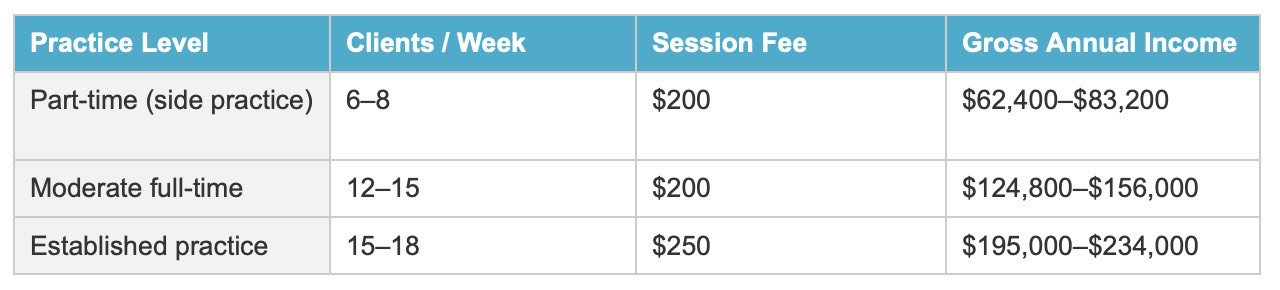
These figures are estimated gross income before business expenses, tax, and superannuation. However, the overhead costs of a clinical hypnotherapy practice are remarkably low compared to most professions, particularly for practitioners who work online or from a home-based clinic. Many practitioners begin part-time while maintaining existing employment, building confidence and client numbers before transitioning to full-time practice.
Watch this to see Joanne who went from a personal trainer to a therapist and is successfully working in her clinic, full time.
The Opportunity in Front of You
Australia’s mental health workforce shortage is not a problem that will solve itself. The demand is structural, the training pipelines for traditional professions are at capacity, and the population’s need for accessible, effective mental health support is growing every year.
Clinical hypnotherapy, delivered through a sophisticated framework like strategic psychotherapy, offers a faster, evidence-backed pathway into this workforce for people who genuinely want to help. It is not a replacement for psychology or psychiatry. It is a vital, complementary piece of a system that urgently needs more trained professionals.
If you have ever considered a career change into a helping profession, if you have ever felt drawn to understanding how the mind works and using that understanding to relieve suffering, this is the moment. The need is real, the evidence is strong, the training is accessible, and the career is rewarding.
The 11271NAT Diploma of Clinical Hypnosis and Strategic Psychotherapy is the only government-accredited qualification in Australia that teaches non-script Neo-Ericksonian hypnosis, strategic psychotherapy, and the Gordian Pillars framework. It is delivered by the Institute of Applied Psychology, with flexible options designed for adult learners.
To take the first step, call 1300 915 497 or download the course brochure.
Frequently Asked Questions
Is there a shortage of mental health professionals in Australia?
Yes. The Australian Government’s April 2026 Psychology Supply and Demand Study found a current shortfall of over 10,000 psychologists, projected to grow to more than 24,000 by 2038. The broader mental health workforce faces an estimated 34–42% shortfall across all disciplines.
Can I become a clinical hypnotherapist without a psychology degree?
Yes. A psychology degree is not required. The standard training pathway is a government-accredited diploma such as the 11271NAT Diploma of Clinical Hypnosis and Strategic Psychotherapy. This qualification provides comprehensive training in hypnotic technique, therapeutic frameworks, and ethical practice. Many graduates enter the field from entirely unrelated backgrounds.
How long does it take to become a qualified clinical hypnotherapist?
The 11271NAT Diploma of Clinical Hypnosis and Strategic Psychotherapy can be completed through flexible delivery, significantly faster than the six-plus years required for a psychology registration. Most students complete the qualification while continuing to work in their current role.
Is clinical hypnotherapy evidence-supported?
Yes. A 2024 mega-review in Frontiers in Psychology analysed 49 meta-analyses and 261 primary studies. Over 54% of reported effect sizes were medium or large. The U.S. National Center for Complementary and Integrative Health designated hypnotherapy a “high programmatic priority” for research funding in 2021, and a 2026 meta-analysis of Ericksonian hypnotherapy RCTs found large effect sizes compared to minimal interventions.
How much can I earn as a clinical hypnotherapist in Australia?
Most clinical hypnotherapists charge between $200 and $300 or more per session. A practitioner seeing 12–15 clients per week at $200 per session can earn approximately $124,800–$156,000 per year gross. Earnings depend on location, specialisation, client load, and business model.
What is strategic psychotherapy?
Strategic psychotherapy is a therapeutic approach that focuses on identifying the specific patterns maintaining a client’s problem and intervening to interrupt them, rather than exploring historical origins. Combined with clinical hypnosis, it typically produces results in 4–8 sessions. The Gordian Pillars of Psychotherapy, developed by Gordon Young at IAP, are a structured diagnostic framework within this approach.
What conditions do clinical hypnotherapists treat?
Clinical hypnotherapists commonly work with anxiety, stress, insomnia, smoking and habit change, phobias, chronic pain, weight management, performance issues, and grief. These are among the most prevalent mental health presentations in Australia and are within the scope of a well-trained clinical hypnotherapist.
Will demand for clinical hypnotherapists continue to grow?
All indicators point to sustained growth. Mental health service demand is rising year on year, traditional training pathways cannot produce enough graduates, and the ageing of the existing psychology workforce will accelerate the shortfall over the next decade. Clinical hypnotherapy, as an evidence-supported complementary profession, is well-positioned to meet part of this demand.