

5 Possible Career Outcomes for Corporate and HR Career Changers
Overview
Across Australia, a growing number of corporate professionals, people leaders and HR practitioners are looking at counselling as their next chapter. Some want out entirely. Others want to stay where they are, but stop feeling like they’re improvising every time an employee cries in a meeting room.
Both are legitimate paths, and the timing is unusually good for either one.
This article walks through what’s driving the shift, what your corporate or HR background is actually worth in a counselling context, where career changers realistically land, what the money looks like (honestly, including where the salary figures disagree), and the granular steps to get from “I’ve been thinking about this” to qualified and practising.
Key Takeaways
- HR is carrying the load and feeling it. International research across nearly 3,000 HR professionals found 38% are considering leaving the profession, with roughly one in four having taken time off in the past year due to stress or mental wellbeing difficulties.
- Counselling is a mature-entry profession. Jobs and Skills Australia puts the median age of Australian counsellors at 44, with around 40,000 people employed in the occupation and roughly 3,400 added annually.
- Your corporate skills transfer more than you think. Difficult conversations, conflict resolution, confidentiality, stakeholder management, working to a process under emotional pressure — these are foundations, not baggage.
- You don’t have to leave to benefit. Many HR and leadership professionals complete counselling training to work more skilfully in their existing role, then decide later whether to go further.
- There are two realistic destinations, not one. Employment (EAP, inhouse, community services, telehealth) and private practice — and around one in five Australian counsellors do both, according to the ACA Workforce Census.
- The entry pathway is clearer than most people expect. The ACA-accredited CHC51015 Diploma of Counselling is the standard vocational entry point, typically completed in 12–18 months, online, alongside work.
Why This Conversation Is Happening Now
Ten years ago, if a senior manager said they were leaving to become a counsellor, the response was usually a raised eyebrow and a quiet question about whether everything was alright at home.
That’s changed. And it hasn’t changed because of a vibe shift. It’s changed because the data underneath Australian workplaces and AI-based roles have shifted.
The regulatory floor moved under everyone’s feet
This is the part HR professionals feel most acutely.
Every Australian jurisdiction now has explicit, enforceable duties to identify and control. From 1 July 2026, NSW-approved Codes of Practice became legally enforceable compliance benchmarks under section 26A of the WHS Act 2011 (NSW), meaning a regulator no longer needs to prove harm occurred.
Here’s the detail that matters for career direction: under these frameworks, an EAP is not a control. Neither is a training session or an awareness day. They’re valuable, but they sit low in the hierarchy of controls. Regulators are asking whether the work itself — the workload, the job design, the management practice — has been assessed and changed.
Think of it like fire safety. Extinguishers on the wall are good. But if the inspector finds you’ve been storing solvents next to the switchboard, “we have extinguishers” is not the answer they’re looking for.
That shift is why organisations are hiring differently. Psychological safety, early intervention and genuine wellbeing capability have become roles, not add-ons. And the people who understand *both* organisational systems *and* human distress are rare.
And HR is running on empty
The 2026 HR Mental Wellbeing Report, drawing on responses from nearly 3,000 HR professionals over three years, found more than a third (38%) were considering leaving the profession, and almost one in four had taken time off in the last year because of stress or similar circumstances.
Beyond Blue research in 2025 found roughly half of Australian workers had experienced burnout in the previous year and that around one in three don’t feel they can raise it with their manager.
If you’re in HR, you already know this. You’re the person people come to at 4:50pm on a Friday. You hold the redundancy conversations, the investigations, the grief, the complaints. You do it without supervision, without a debrief, and often without training in the thing you’re actually being asked to do.
That’s not a character flaw. That’s a scope problem.
Two Different Doors
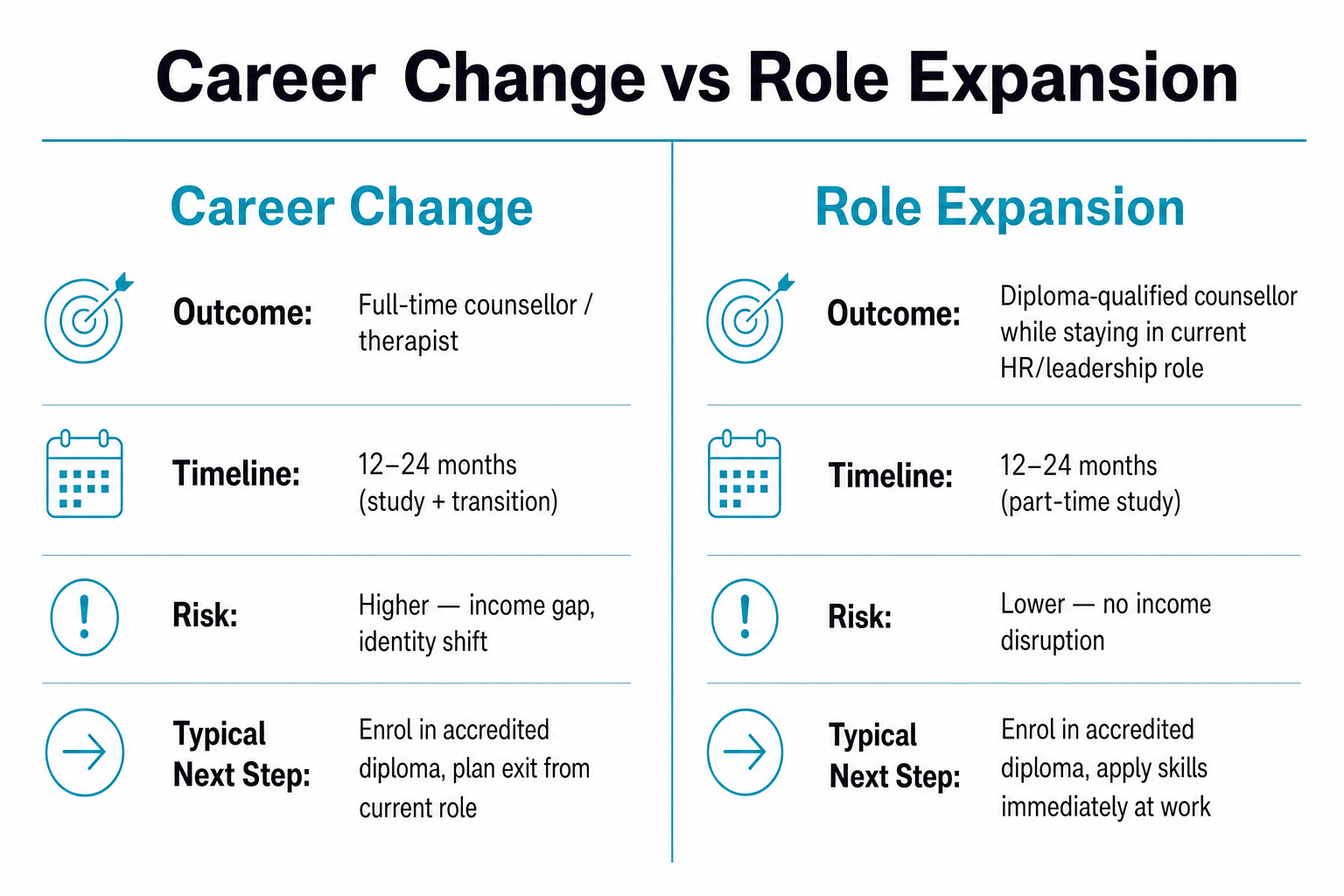
Most articles on this topic assume you want to quit. Many people don’t. Be clear with yourself about which door you’re standing at, because the training decision looks different.
Door 1: The career change
You want out of corporate. You want to be the person in the room helping one human at a time, not managing a spreadsheet of headcount.
What this looks like in practice: you study while still employed, qualify, take on volunteer or placement hours, pick up part-time counselling work or start seeing a small number of private clients, and taper out of your corporate role over 12–24 months.
Door 2: The role expansion
You’re staying in HR, people and culture, safety, or leadership but you want to be genuinely skilled rather than winging it.
What this looks like in practice: you complete counselling training to sharpen how you handle disclosure, distress, conflict and difficult conversations. You don’t practise as a counsellor inside your organisation, that’s a boundary and a conflict-of-interest issue, but you become vastly better at recognising, responding and referring.
A worked example. An employee tells you they’re not coping. Before training, the instinct is to fix: “Have you thought about taking some leave? I’ll email you the EAP number.” After training, you notice what you’re doing — reaching for a solution to end your own discomfort. Instead you slow down, reflect back what you’ve heard, check what support they already have, ask what would actually help, and *then* make a warm referral rather than a phone number in an email. Same five minutes. Completely different outcome.
Plenty of people walk through Door 2 and end up at Door 1 eighteen months later. That’s a perfectly reasonable way to test the water.
What Counselling Actually Looks Like in Australia
Before romanticising it, look at the workforce.
According to Jobs and Skills Australia:
- 40,000 People Employed as Counsellors
- 44 Median Age (vs 39 across all occupations)
- 40% Work Part-time
- 71% Are Women
- $1,477/week Median Full-time Earnings (before tax)
- ~3,400 Annual Employment Growth (new roles per year)
Jobs and Skills Australia’s projection series has counsellor numbers growing by around 15% across a five-year horizon — one of the stronger growth profiles in the social and welfare professional group.
Where counsellors actually work
The Australian Counselling Association’s Workforce Census found the following:
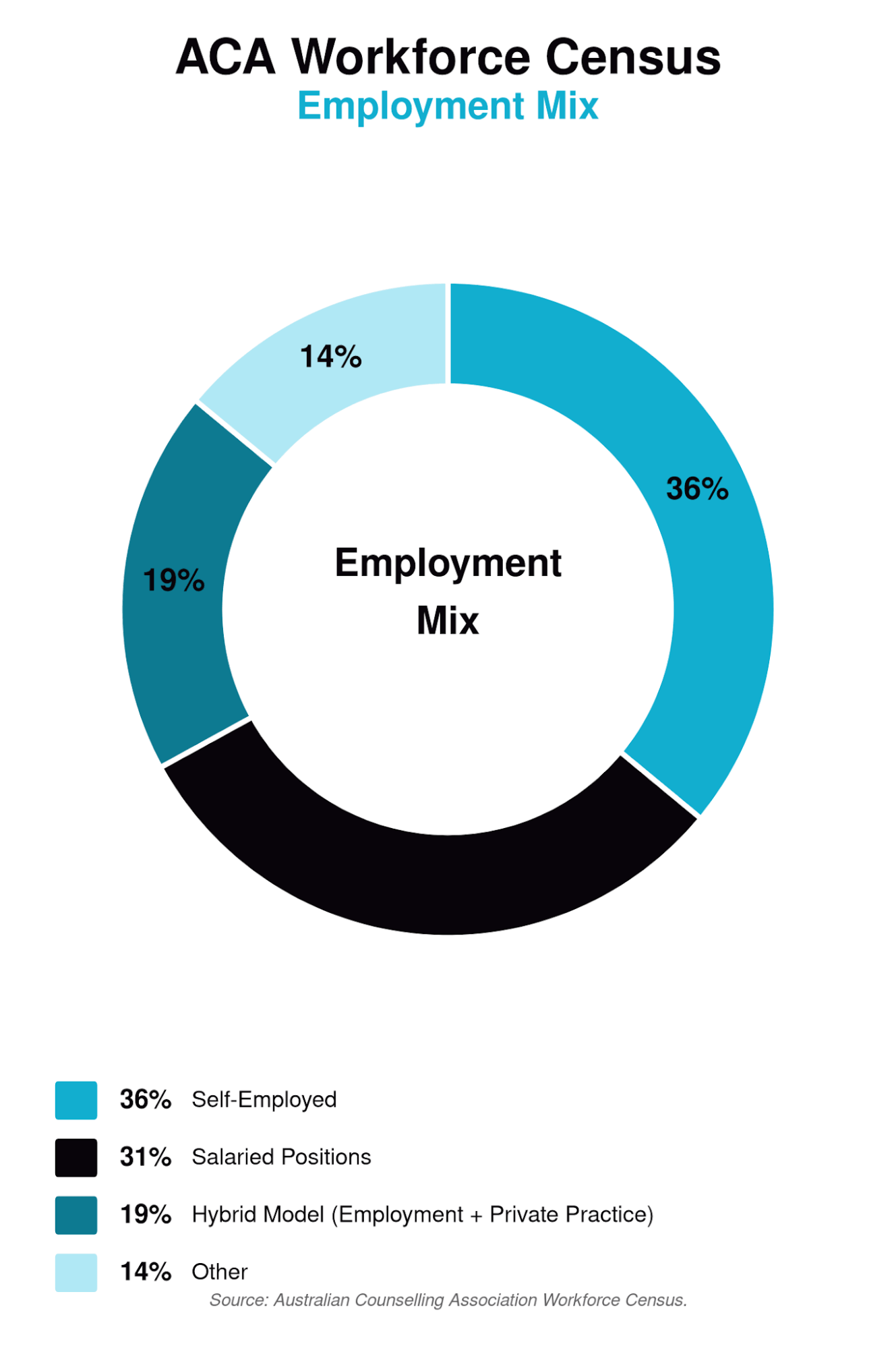
That last figure is the one corporate and HR career changers should notice. Nearly one in five is running a hybrid model: a salaried base plus their own clients. If you’ve spent twenty years with a predictable pay cycle, a hybrid is usually a gentler transition than jumping straight into private practice.
What Your Corporate or HR Background Is Actually Worth
Here’s the reframe: you are not starting from zero. You’re starting from a different discipline.
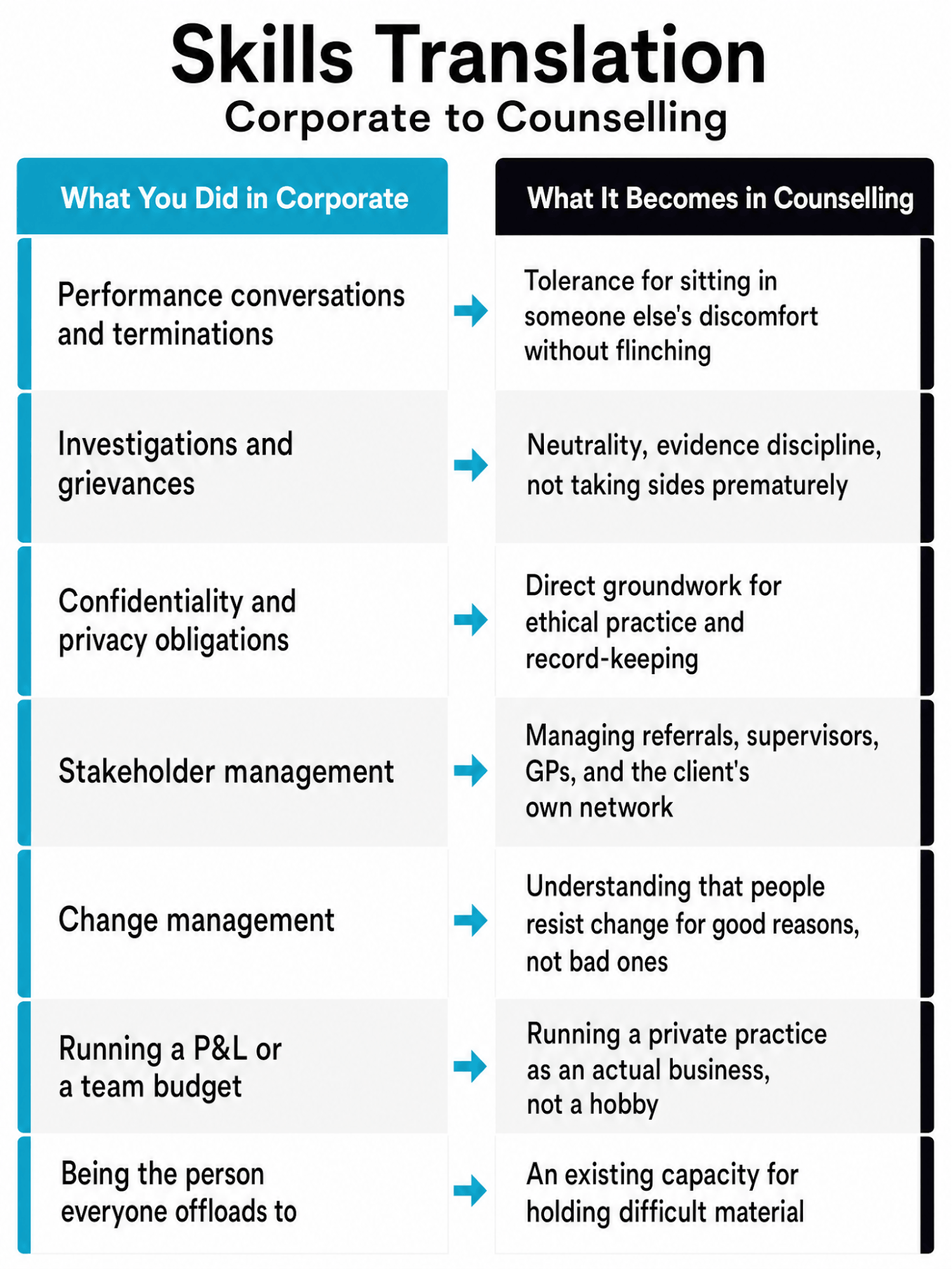
The analogy that lands for most people: the qualification teaches you to play the instrument. Your working life gives it tone. A twenty-two-year-old graduate has the technique. You have the technique and twenty years of knowing what it feels like when a restructure lands, when a marriage strains under a workload, when someone’s identity is fused to a job title they’re about to lose.
Clients notice the difference. So do employers.
That said, one honest caution. Corporate rewards the fixer. Counselling doesn’t. The single hardest habit for career changers to unlearn is the reflex to solve, advise, and move the conversation towards resolution before the person has finished being understood. Good training makes you aware of the reflex. Supervision keeps you honest about it for the rest of your career.
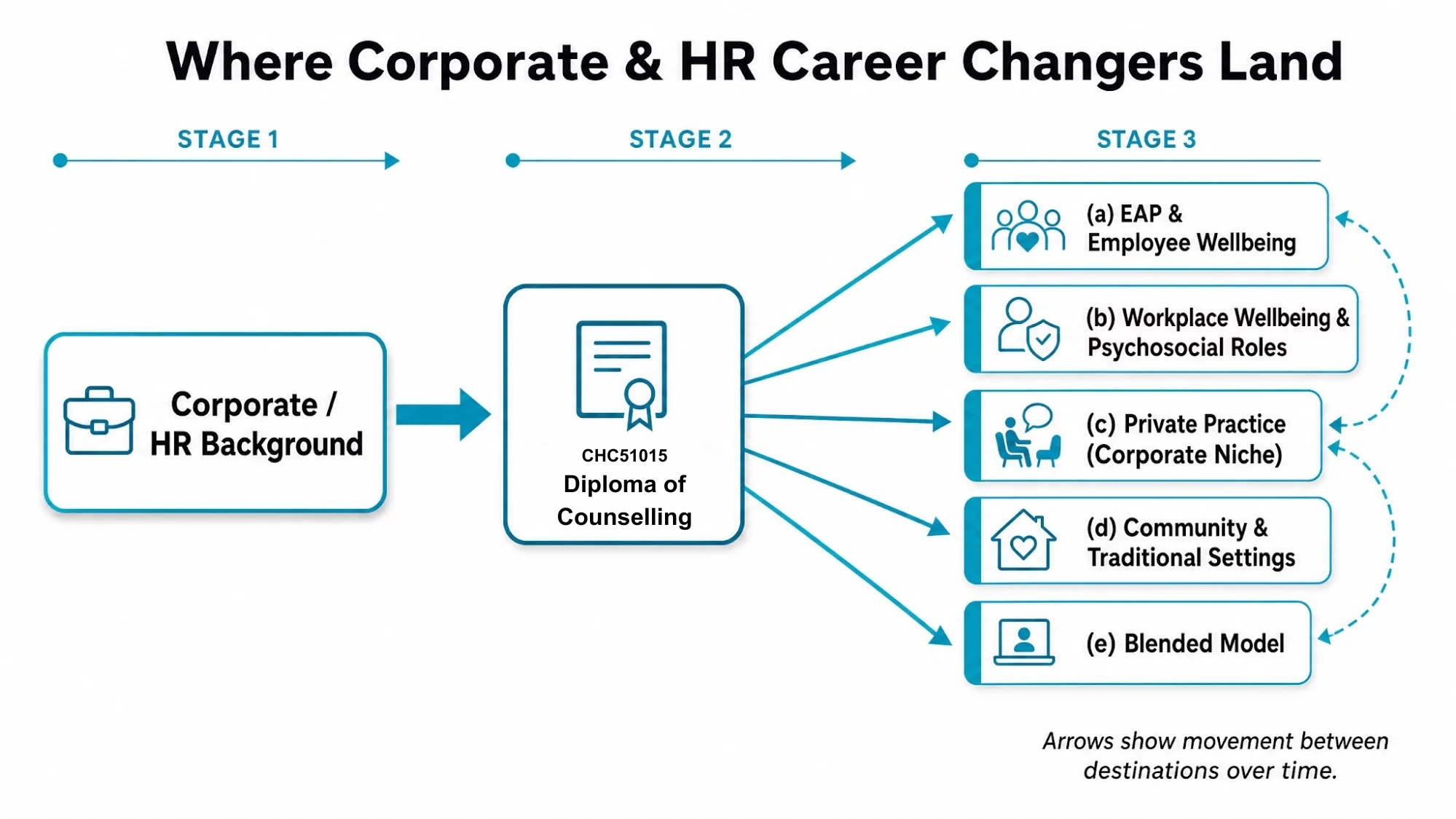
5 Possible Career Outcomes for A Counselling Career Changer
This is the section most people are searching for. Realistic destinations, not aspirational ones.
- EAP and employee wellbeing counselling. EAP work is short-form, solution-focused, often telehealth, and heavy on workplace-related presentations: stress, conflict, restructures, bullying complaints, career transitions. Someone who has *lived inside* a corporate structure has an enormous advantage here — you understand what a performance improvement plan actually is, what a matrix reporting line does to someone, and why “just escalate it to your manager” isn’t always safe advice. EAPs remain widespread among large Australian employers, with a large and competitive provider market.
- Inhouse counselling roles. Wellbeing lead, mental health and wellbeing partner. These sit in HR, safety, or a standalone people function. Counselling training plus your existing organisational credibility is a genuinely uncommon combination — and, given the regulatory changes above, an increasingly sought one.
- Private practice with a corporate niche. Executive burnout. Career transition. Redundancy and identity. Founders and business owners. This is where your background stops being a footnote in your bio and becomes the reason clients choose you. A counsellor who says “I spent fifteen years in professional services” will get calls from people in professional services.
- Traditional counselling settings. Community services, family and relationship services, youth services, disability, telehealth platforms, school-based wellbeing roles (noting these can carry additional requirements depending on the state and sector).
- A blended model. Two or three days salaried, two days private, gradually shifting the ratio. The most common route for people who need income continuity.
What Can You Actually Earn?
You’ll find two very different sets of numbers online, so here are both.
- Jobs and Skills Australia (based on ABS earnings data) reports median full-time earnings of $1,477 per week before tax — roughly $77,000 a year.
- Advertised salary data (SEEK and similar) commonly shows counsellor salaries in the $95,000–$115,000 range, with some regional and specialist roles higher.
- Private practice rates commonly sit at $150+ per hour, though gross session fees are not take-home income once you subtract supervision, insurance, registration, rooms, software, marketing, admin time and unbilled hours.
Why the gap? Advertised salaries skew towards full-time, senior, metropolitan and hard-to-fill roles. Actual workforce earnings include part-time-heavy, community and not-for-profit work. Both numbers are real; they’re measuring different things.
Am I Too Old For This?
The median age of an Australian counsellor is 44. Jobs and Skills Australia’s age profile shows the largest single cohort sits in the 45–54 bracket, with more than a quarter of the workforce there, and around 18% aged 60 and over.
You are not too old. You are, statistically, right on time.
There’s no upper age limit for study, no age limit on professional membership, and age discrimination in hiring is unlawful. The more useful question isn’t *”Am I too old?” — it’s “Am I ready to be a beginner again for a while?”
That one’s worth sitting with. Going from the person who knows the answers to the person on placement being observed is a real ego adjustment. Most career changers describe it as humbling for about three months and energising after that.
The Pathway, Step by Step
Step 1 — Test the assumption (1–4 weeks, free).
Talk to two or three practising counsellors, ideally one in EAP work and one in private practice. Ask what a Tuesday actually looks like, what they earn, and what they’d do differently. Read a course outline properly. Sit with the idea of doing this for a decade, not a year.
Step 2 — Choose your qualification (2–4 weeks).
The standard vocational entry point in Australia is the CHC51015 Diploma of Counselling, delivered by a registered training organisation. No prior degree is required. It’s competency-based rather than exam-based, and it’s typically completed in 12–24 months studying online alongside work. Confirm the course is accredited by the Australian Counselling Association (ACA) — this matters for membership eligibility, insurance, and how employers read your résumé.
Step 3 — Study while employed (Up to 24 months).
Most mature-age students keep working. Block protected study time in your calendar the way you’d block a client meeting — the people who struggle are almost always the ones treating study as what happens if there’s time left over.
Step 4 — Apply for professional membership.
Graduates can apply for membership with bodies including the Australian Counselling Association, and depending on scope of practice, the Australian Traditional Medicine Society (ATMS) and the International Institute for Complementary Therapists (IICT). Membership underpins ethical practice, professional indemnity insurance, and credibility with employers. ATMS membership may also support eligibility for selected private health fund rebates, depending on your scope, provider status and insurance.
Step 6 — Line up supervision.
Non-negotiable. Clinical supervision is how you stay ethical, effective and well. Budget for it from day one — it’s a cost of doing business, not a luxury.
Step 7 — Start narrow, then transition.
Take a part-time counselling role, a few EAP shifts, or three or four private clients a week while keeping your income. Reduce corporate hours as counselling income becomes predictable. Very few people benefit from resigning first.
Step 8 — Specialise deliberately.
After six to twelve months of practice you’ll know what you’re drawn to. This is where your corporate history becomes a positioning asset rather than a past life.
The Honest Downsides
It would be a strange article about counselling that skipped this.
- It could be emotionally demanding. People bring you their hardest material. Without supervision and boundaries, this profession will find your soft spots.
- Income could be slower to initially build, especially in private practice, where you’re building a referral base from scratch.
- Admin doesn’t disappear. Notes, consent, privacy, record-keeping, invoicing.
- Ongoing professional development is permanent, not optional.
- Counselling is not psychology. Different training, different scope. Counsellors work with emotional challenges, relationships, life transitions, stress and personal development; psychologists undertake formal assessment, diagnosis and registration-based practice. Know which one you’re actually describing when you picture your future.
If you read that list and felt more curious than deterred, that’s a useful signal.
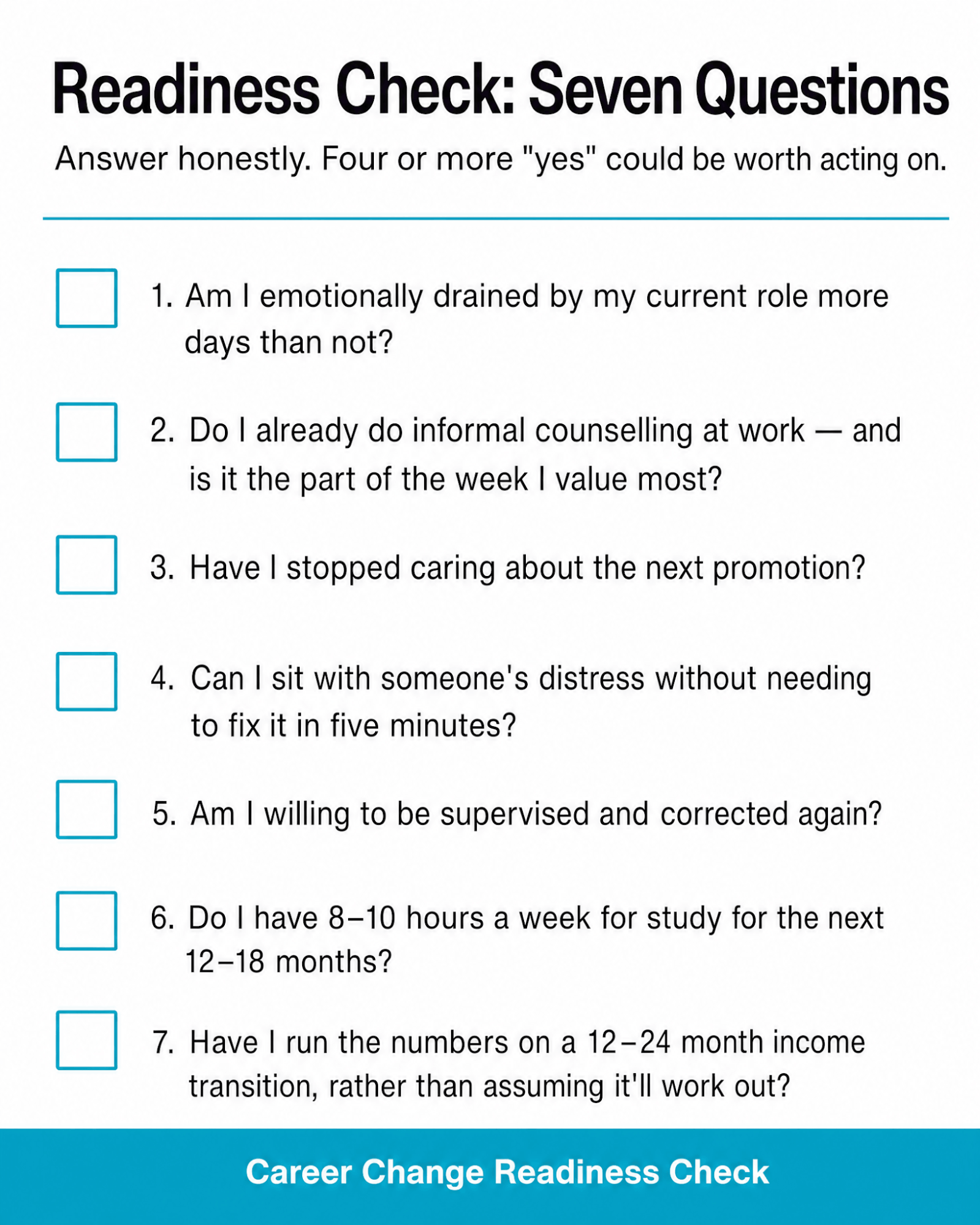
Are you ready to become a counsellor?
Answer honestly. Four or more yes could be worth acting on for you.
Frequently Asked Questions
Can I become a counsellor in Australia without a university degree?
How long does it take to retrain as a counsellor?
Can I study counselling while working full-time in a corporate or HR role?
Am I too old to become a counsellor at 45 or 50?
Can I use counselling skills inside my HR role without becoming a counsellor?
What is the difference between a counsellor, a psychologist and a social worker?
What do counsellors earn in Australia?
Is there real demand for counsellors in Australia?
Do I need my own therapy or supervision to do this work?
The Real Question
Most people don’t wake up one morning and decide to become a counsellor. It starts earlier, and quieter, usually as a question that keeps returning on the drive home.
What if my work could mean more than this?
For some people, counselling turns out to be the answer. For others, exploring it clarifies something different. Both outcomes are worth having, because the goal was never simply another job title. It was building a working life that fits who you’ve actually become.
If you’d like to talk about your options for transitioning your corporate career into counselling, or add counselling to your corporate career, or see what the ACA-accredited CHC51015 Diploma of Counselling involves, call our IAP team on 1300 915 497 or download the course outline.
Sources
– Safe Work Australia, *Key Work Health and Safety Statistics Australia 2025* (October 2025)
– Jobs and Skills Australia, Occupation Profile: Counsellors (ANZSCO 2721), August 2025 data
– Jobs and Skills Australia, Employment Projections
– Australian Bureau of Statistics, *National Study of Mental Health and Wellbeing*
– Australian Institute of Health and Welfare, Mental Health
– Australian Counselling Association, Workforce Census
– *Occupational Health and Safety (Psychological Health) Regulations 2025* (Vic), commenced 1 December 2025
– *Work Health and Safety Act 2011* (NSW), s 26A; *Work Health and Safety Regulation 2025* (NSW)
– Beyond Blue workplace burnout research, 2025
– HR Mental Wellbeing Report 2026 (international HR profession research)
– SEEK career advice — counsellor salary data