


The 7 Soft Skills That Determine Whether a Career or a Business Survives
Soft skills training delivers a 256 per cent return on investment. Not 25 per cent. Not even 100 per cent. Two hundred and fifty-six per cent, measured across productivity and retention in a peer-reviewed study published in the Journal of Political Economy by researchers from Harvard University, Boston University and the University of Michigan’s Ross School of Business.
And yet, most people preparing for a career in business or planning to start their own venture focus almost entirely on technical skills: financial modelling, marketing platforms, software tools. The research says they are solving the wrong problem. 75 per cent of long-term job success is determined by soft skills mastery and only 25 per cent by technical skills, according to the Carnegie Mellon Foundation.
Whether you are starting a career in management, building a side hustle into a real business, or trying to figure out why your current role feels stuck, this guide, developed by the Institute of Applied Psychology (IAP), Australia’s Training Excellence Award-winning RTO, walks you through the soft skills that separate people who succeed in business from those who struggle. It explains what they are, why they matter more than ever in 2026, which ones are most correlated with business survival, and how to build them practically.
5 Key Facts
- Soft skills training delivers 256% ROI through increased productivity and retention (Harvard, Boston University, University of Michigan — Journal of Political Economy).
- Soft skill-intensive occupations will account for two-thirds (63%) of all Australian jobs by 2030, growing at 2.5× the rate of other jobs (Deloitte Access Economics / DeakinCo).
- 75% of long-term job success is determined by soft skills and only 25% by technical skills (Carnegie Mellon Foundation). Companies with strong leadership and communication are 23% more likely to outperform peers (Emeritus, 2026).
- 38% of startups fail due to lack of financial skills and 60% fail specifically from cash flow problems (CB Insights). The Australian Banking Association cites insufficient leadership and poor financial management as the top causes of small business failure.
- The demand for soft skills in Australia exceeds supply by up to 45% (DeakinCo / Deloitte), making these the highest-return skills for career advancement and business survival.
What Are Soft Skills in Business?
Soft skills are the interpersonal, communication, emotional and behavioural capabilities that determine how effectively you work with people, manage yourself and navigate complex situations. They include communication, leadership, emotional intelligence, adaptability, critical thinking, problem-solving and teamwork. Unlike technical or “hard” skills, which are specific to a role or industry, soft skills are transferable across every business environment, every career stage and every sector.
A 2025 Delphi study published in MDPI Administrative Sciences, surveying 20 experts across multiple countries, confirmed that communication, adaptability, teamwork and critical thinking are essential for business success, while leadership, emotional intelligence, problem-solving and teamwork are considered the most vital skills for future entrepreneurs specifically.
Analogy: If hard skills are the tools in your toolbox (the hammer, the saw, the drill), soft skills are the hands that hold them. You can own every tool in the world, but if your hands are clumsy, nothing gets built well.
Why Soft Skills Matter More Than Technical Skills in 2026
This is not an opinion. It is a consistent finding across multiple independent research streams.
Deloitte Access Economics forecasts that soft skill-intensive occupations will account for 63 per cent of all Australian jobs by 2030, up from roughly half in 2000. The number of jobs in soft skill-intensive occupations is growing at 2.5 times the rate of jobs in other occupations. This is not a marginal shift. It is a structural transformation of the labour market.
The World Economic Forum’s Future of Jobs Report 2025 predicts that creative thinking, resilience, flexibility and agility will be among the fastest-growing skills in the next five years. These are soft skills. Meanwhile, companies that prioritise leadership and communication skills are 23 per cent more likely to outperform their peers (Emeritus, 2026).
In Australia specifically, the gap between job market demand for soft skills and the available supply exceeds 45 per cent (DeakinCo / Deloitte). Jobs and Skills Australia identifies emotional intelligence, critical thinking, communication and people leadership as the most sought-after and most shortage-prone capabilities in business roles. The skills employers need most are the ones fewest candidates have. That is both the challenge and the opportunity.
71 per cent of employers now prioritise emotional intelligence over IQ when evaluating candidates. 59 per cent of hiring managers say they would not hire someone with a high IQ but low EQ. The message is clear: technical competence gets you through the door, but soft skills determine whether you stay, advance and lead. To explore how emotional intelligence specifically drives career success, see our in-depth guide: How Emotional Intelligence Gives You an Unfair Advantage in Australian Workplaces.
| Not sure which business course fits your goals? Take IAP’s free 2-minute Course Finder Quiz to get a personalised recommendation, or call 1300 915 497 to speak with an education advisor. |
The 7 Soft Skills That Determine Whether a Career or a Business Survives
There are 2.73 million actively trading businesses in Australia. 97.3 per cent are small businesses. Only 75 per cent survive past their first year, and approximately 60 per cent fail within three years.
The reasons they fail are not random. The Australian Banking Association identifies the top causes as insufficient leadership and management, inadequate market research and poor financial management. CB Insights research adds: 38 per cent of startups fail from lack of financial skills and 60 per cent fail specifically from cash flow problems. 42 per cent fail from no market need, 23 per cent lack the right team, 19 per cent get outcompeted.
Every single one of these failure causes maps to a learnable soft skill. Here are the seven that matter most:

42 per cent of business failures stem from lack of market need, often because the founder never learned to listen to customers, ask the right questions or communicate their value proposition clearly. Communication is not just “being a good talker.” It is the ability to listen actively, present ideas persuasively, write with clarity and adapt your message to different audiences. The SHRM estimates that miscommunication costs companies of 100 employees an average of $420,000 per year. For a small business with tighter margins, the proportional cost is even higher.

38 per cent of startups fail because of financial skill gaps and 60 per cent fail specifically from cash flow problems. Financial literacy is not accounting. It is the ability to read a profit and loss statement, understand your cash flow cycle, set pricing that actually works and forecast whether you can afford to hire next quarter. Without it, even profitable businesses can collapse because revenue does not equal cash in the bank.

23 per cent of failed businesses cite the wrong team as a primary cause. Leadership is not a title. It is the ability to set direction, build trust, hold people accountable and create an environment where others can do their best work. Managers who incorporate soft skills into their leadership approach increase their team’s performance by as much as 30 per cent (Hay Group). For an overview of the specific leadership skills employers value most, see 10 Skills for Business Leaders in 2026.

71 per cent of employers prioritise EQ over IQ when evaluating candidates. Emotional intelligence, the ability to recognise, understand, manage and use emotions effectively, underpins every other soft skill on this list. It is what allows you to have difficult conversations without destroying relationships, to read a room before making a pitch, and to manage your own stress without it leaking onto your team. IAP has published a comprehensive exploration of this topic: How Emotional Intelligence Gives You an Unfair Advantage in Australian Workplaces.

Every business encounters problems daily. The difference between businesses that navigate them and businesses that are consumed by them is not luck. It is the ability to analyse a situation objectively, identify root causes rather than symptoms, weigh options against evidence and make decisions under imperfect information. In an era where AI handles the routine analysis, critical thinking about what to do with the analysis is the distinctly human skill that matters.

The World Economic Forum rates resilience, flexibility and agility among the fastest-growing skills for the future of work. 19 per cent of businesses fail because they get outcompeted by faster-moving rivals. Adaptability is not about abandoning your strategy at every setback. It is about updating your approach when the evidence changes, pivoting before a small problem becomes a crisis and maintaining focus under pressure. Harvard Business Review research shows that the average age of entrepreneurs at first successful venture is approximately 45, which suggests that resilience and accumulated judgment, not youthful energy, are what drive entrepreneurial success.

Businesses that build proper systems and infrastructure early are approximately 40 per cent more likely to still be operating at three years. Continuous improvement is the discipline of regularly reviewing your processes, products, team performance and customer feedback, and making incremental adjustments. It is what separates businesses that plateau from businesses that compound their growth over time.
Soft Skills vs Hard Skills: Which Matters More?
The honest answer: you need both. But the research consistently shows that soft skills carry more weight than most people assume.
| Factor | Soft Skills | Hard Skills |
| Share of job success | 75% (Carnegie Mellon Foundation) | 25% (Carnegie Mellon Foundation) |
| ROI of training | 256% (Harvard/Boston/Michigan) | Varies widely by field |
| Transferability | Across all industries and roles | Often industry or role-specific |
| Shelf life | Durable; compounds over career | ~2.5 years before updating needed |
| Employer priority | 71% of employers prioritise over IQ | Essential baseline, not differentiator |
| Supply vs demand | Demand exceeds supply by 45% (AU) | Closer to equilibrium in most fields |
| AI disruption risk | Low — inherently human | High — many automatable |
The data does not say hard skills are unimportant. You cannot manage a budget without financial literacy. You cannot build a website without technical knowledge. But hard skills are the minimum entry requirement. Soft skills are the differentiator. They are what determine whether you get promoted, whether your team performs, and whether your business survives.
Can You Actually Learn Soft Skills?
Yes. This is one of the most well-established findings in the research. The peer-reviewed study published in the Journal of Political Economy found that soft skills training delivered a 256 per cent ROI within eight months of program completion. Workers who received training in communication, problem-solving and self-awareness were 12 per cent more productive than those without it, and the benefits extended to untrained coworkers on the same production lines, confirming that soft skills improve team performance, not just individual performance.
The 2025 MDPI Delphi study confirmed that group projects, specialised courses and blended learning approaches are effective methods for developing soft skills. Workplace mentoring, collaboration and feedback loops were identified as the strongest workplace-based development methods.
Nexford University’s research emphasises that entrepreneurial mindset and skills are not purely innate: “While certain personality traits like confidence and tolerance for risk may give someone a head start, the specific skills needed to build and run a business — strategic planning, financial analysis, marketing — are absolutely learnable.”
Analogy: Soft skills are like a language. Nobody is born speaking French. Some people have a natural ear for it, but anyone can learn it with structured practice, feedback and immersion. The difference between someone who is “naturally good with people” and someone who has developed their communication skills through training is like the difference between someone who picked up some French on holiday and someone who studied it properly. Both can order coffee. Only one can negotiate a contract.
How to Build These Skills
The Bottom Line
Soft skills are not a “nice to have” sitting alongside the real work. They are the real work. They account for 75 per cent of long-term job success. They deliver 256 per cent ROI when trained deliberately. They are the exact skills the Australian labour market is shortest on. And they are the skills most correlated with whether a business survives past its first year.
If you are building a career in business, you need them. If you are starting a business, you need them even more. And the research is unambiguous: they are learnable, they are trainable, and the return on investing in them dwarfs almost any other professional development investment you can make.
|
Take the next step. Not sure whether a BSB50120 Diploma of Business or BSB50420 Diploma of Leadership and Management is right for your goals? Take IAP’s free Course Finder Quiz for a personalised outlook in under 3 minutes. Or call 1300 915 497 to speak directly with an education advisor who can map a pathway tailored to your situation. |
Frequently Asked Questions
What are the most important soft skills for business success?
The seven soft skills most strongly correlated with business success and survival are communication, financial literacy, leadership and people management, emotional intelligence, critical thinking and problem-solving, adaptability and resilience, and continuous improvement. Deloitte Access Economics forecasts that soft skill-intensive occupations will account for 63 per cent of all Australian jobs by 2030, and research from the Carnegie Mellon Foundation shows that 75 per cent of long-term job success is determined by soft skills.
Can soft skills actually be learned, or are they innate?
Soft skills are learnable. A peer-reviewed study published in the Journal of Political Economy by researchers from Harvard University, Boston University and the University of Michigan found that structured soft skills training delivered a 256 per cent return on investment within eight months. Workers trained in communication, problem-solving and self-awareness were 12 per cent more productive, and the benefits extended to untrained coworkers on the same teams.
Why do most small businesses fail in Australia?
The Australian Banking Association identifies the top causes as insufficient leadership and management, inadequate market research and poor financial management. CB Insights reports that 38 per cent fail from financial skill gaps, 42 per cent from lack of market need, 23 per cent from wrong team and 19 per cent from being outcompeted. Each of these causes maps to a specific learnable soft skill.
Do I need a qualification to start a business in Australia?
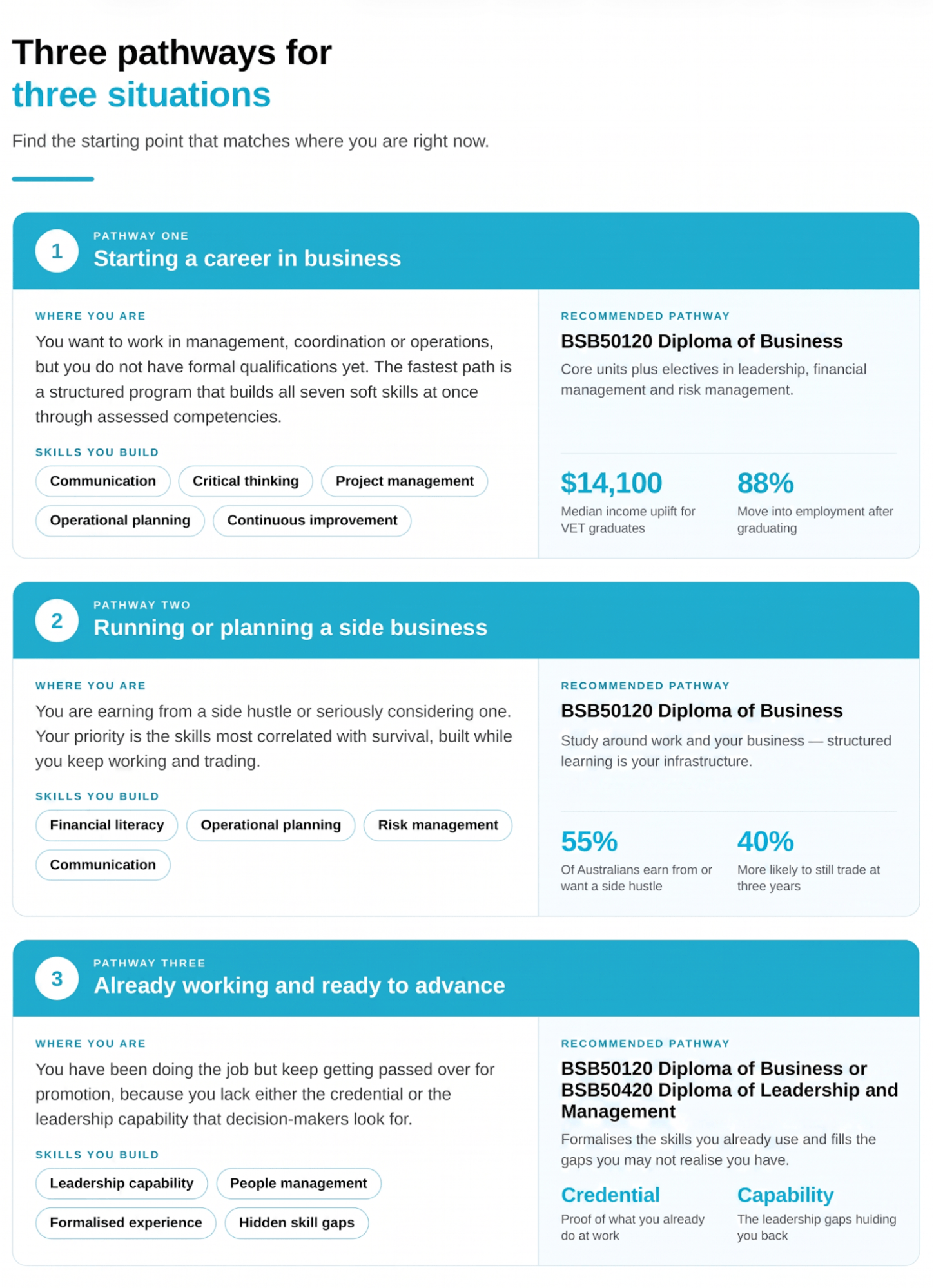
There is no legal requirement. However, only 75 per cent of Australian businesses survive past year one and the businesses that build infrastructure and systems early are 40 per cent more likely to survive to three years. A Diploma of Business builds the foundational skills, financial management, operational planning, risk management and communication, most correlated with business survival.
What is the ROI of soft skills training?
256 per cent, according to a peer-reviewed study published in the Journal of Political Economy (Harvard University, Boston University, University of Michigan). The study measured productivity gains and retention improvements following structured soft skills training. Separately, the Hay Group found that managers who incorporate soft skills into their leadership approach increase their team’s performance by up to 30 per cent.
Are soft skills more important than hard skills for entrepreneurs?
Both matter, but soft skills carry disproportionate weight. The Carnegie Mellon Foundation found that 75 per cent of long-term job success is determined by soft skills and only 25 per cent by technical skills. For entrepreneurs specifically, a 2025 Delphi study confirmed that communication, adaptability, leadership and emotional intelligence are considered the most vital skills for future entrepreneurs. Hard skills are the baseline. Soft skills are the differentiator.
What qualification builds soft skills for business in Australia?
The BSB50120 Diploma of Business builds all seven soft skills covered in this article through competency-based assessment. Core units cover communication, critical thinking, project management, operational planning and continuous improvement. Electives include leadership, financial management and risk management.VET graduates record a $14,100 median income uplift post-qualification. IAP delivers the program fully online for working professionals. Take the free Course Finder Quiz at iap.edu.au/quiz or call 1300 915 497.