


Will AI Replace Coaches? What It Means for Your Career and Income in Australia (2026)
Artificial intelligence is now drafting emails, summarising meetings and even running chatbot “coaching” sessions across Australian workplaces. If you are thinking about becoming a coach; or you already are one; two questions sit behind almost every other worry: will a machine make me obsolete before I’ve really begun, and can I actually earn a living doing this? This article answers both with current data. It explores whether AI is a genuine threat to coaches, what the profession really pays in Australia, and how to build a coaching career that thrives alongside the technology rather than against it.
Key Takeaways
- AI will not replace coaches, but it will reshape the job. It automates the routine layer (reminders, prompts, tracking) while making the human layer more valuable. Around 47% of coaches already use digital platforms in their practice (ICF Global Coaching Study, 2025).
- The profession is growing, not shrinking. A record 122,974 coach practitioners worldwide and an estimated US$5.34 billion in revenue in 2025, with the Australian market valued at roughly AUD $1.2 billion.
- Income varies widely. Independent coaches in Australia commonly charge up to around $300 per session, and credentialed health and life coaches typically charge $90–$180 per hour.
- Credentials pay. 85% of clients value working with a credentialed coach, and credentialed practitioners command higher rates — especially for corporate work, which is the best paid and most AI-resistant.
- The most resilient, best-paid coaches do three things: they specialise, they hold a recognised credential, and they use AI as leverage rather than treating it as a threat.
Will AI Replace Coaches? The Honest Answer
No. The reason is structural, not sentimental. AI coaching tools are real and growing fast, and ignoring them would be a mistake. But the clearest way to think about it is to separate the task of coaching from the relationship of coaching. AI is genuinely good at the first and structurally incapable of the second.
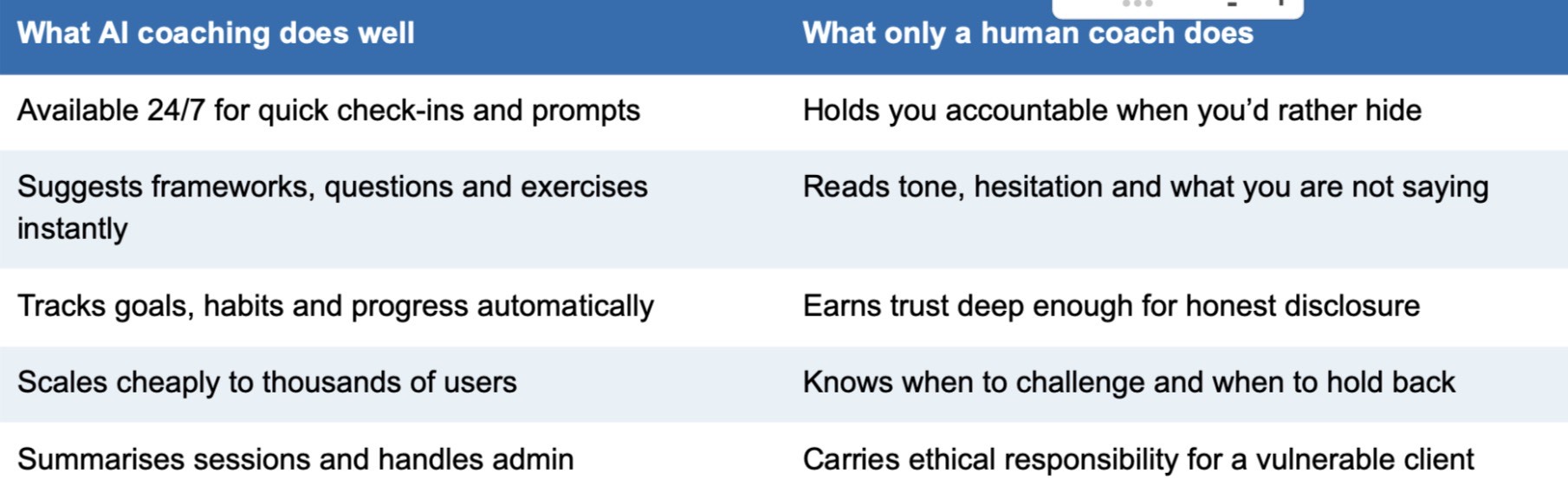
For example, AI is to coaching what a fitness app is to a personal trainer. The app counts your steps, reminds you to move and never sleeps; yet people still pay trainers, because an app cannot notice you have quietly given up, cannot read the day you walked in defeated, and cannot be accountable to you. Coaching has the same shape. The commodity layer is being automated; the human layer is becoming more valuable, not less.
There is also a hard commercial reason human coaches are protected: who pays the bills. More than half of all coaching clients are now employer-sponsored, which means coaching has shifted from a personal luxury to a core part of how organisations develop their leaders and teams. Corporate buyers want a named, accountable, credentialed professional behind a leadership-development investment — not a chatbot. That demand is the moat around the profession.
AI will absorb the low-value, repetitive end of coaching and raise client expectations. Coaches who use it as leverage will earn more per hour. The coaches genuinely exposed are those whose entire offer is “generic advice in a conversation” and they were always the most replaceable, AI or not.
Is Coaching Still a Growing Career?
Yes, and the trajectory is unusually strong for any profession right now. The 2025 ICF Global Coaching Study reported a record 122,974 coach practitioners worldwide, up 15% since 2023 and 54% since 2019, while industry revenue climbed to an estimated US$5.34 billion. Independent analysts project continued growth of roughly 8–9% a year. In short: more coaches and more revenue per coach at the same time, the opposite of a profession being hollowed out by automation.
Australia tracks the global trend. The domestic coaching market was valued at roughly AUD $1.2 billion in 2022, driven by rising interest in personal development, mindset and workplace wellbeing, and by employers building coaching into their leadership pipelines.
What Do Coaches Actually Earn in Australia?
This is where honesty matters most, because the range is genuinely wide and most figures you find online are American. For Australia specifically, the picture looks like this:
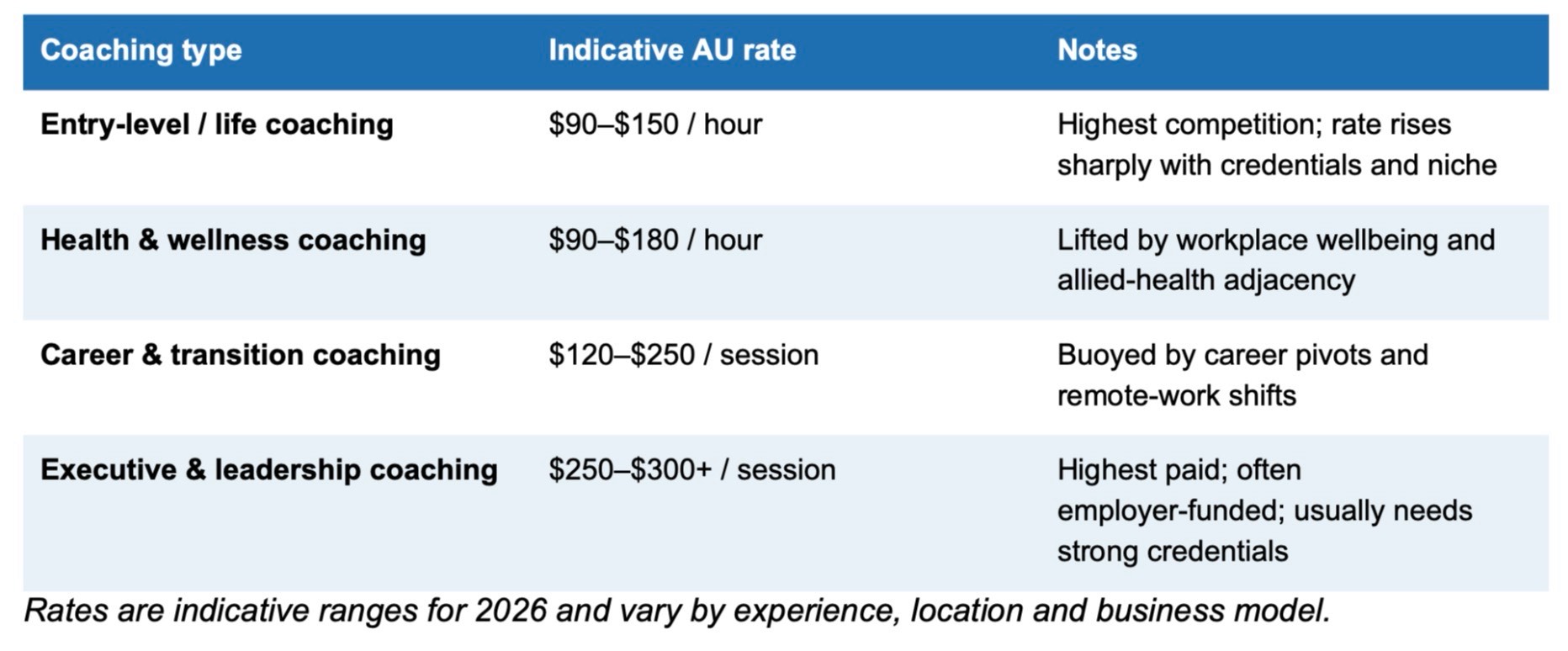
The single biggest variable is not the niche; it is whether you treat coaching as a practice or a business. Two coaches with identical qualifications can earn wildly different incomes purely on client acquisition, packaging (programs versus one-off sessions) and retention. The technology question is almost a sideshow next to this.
Does Being Credentialed Actually Pay More?
Yes, and in Australia, it matters more than people expect, because the industry is unregulated. Anyone can legally call themselves a coach, with no required qualification. In that environment, a recognised credential is not box-ticking; it is your single strongest trust signal and pricing lever. The data backs this up on both sides of the transaction: credentialed coaches reliably command higher rates, and 85% of clients say they value working with a credentialed coach. When the buyer is an employer funding executive coaching, the highest-paying segment, an ICF credential such as the ACC or PCC often shifts from “nice to have” to non-negotiable. The credential does two jobs at once: it lets you charge more, and it qualifies you for the work that pays the most and is most insulated from AI.
Which Niches Are Growing?
If you are choosing a direction with both demand and income in mind, three areas stand out in the current data:
- Executive and leadership coaching — consistently the highest-paying niche and among the fastest-growing, propelled by sustained corporate investment and employer-sponsored coaching.
- Health and wellness coaching — buoyed by workplace wellbeing programs and growing public interest in preventative, behaviour-change support.
- AI-augmented coaching — not a niche you compete with so much as a layer you add: packaging digital tools alongside human sessions to serve more clients at better margins.
The pattern across all three is that the money is moving toward coaches who specialise, hold a recognised credential, and use technology as leverage.
How to Future-Proof Your Coaching Income
- Pick a niche with employer demand. Executive, leadership and workplace-wellbeing coaching are the most AI-resistant and best paid, because the buyer wants an accountable human. “Leadership coach for first-time managers” will out-earn “life coach” almost every time.
- Get a recognised credential. In an unregulated market, an ICF-aligned credential is your clearest trust signal and your strongest justification for premium rates.
- Use AI as your assistant, not your competitor. Let tools handle scheduling, summaries and between-session prompts, so your paid time goes to the high-value human work clients will not pay a machine for.
- Sell programs, not one-off sessions. A six-session package with a clear outcome is easier to price, easier to sell and produces more predictable income than hourly billing.
- Treat client acquisition as a real skill. The widest income gap between coaches is not qualification — it is whether they can reliably find and keep clients. Budget time and learning for marketing from day one.
Frequently Asked Questions
Will AI replace life coaches?
No. AI is automating the routine layer of coaching and raising client expectations, but it cannot typically provide the trust, accountability and human judgement clients actually pay for. Coaches who adopt AI tend to earn more, not less.
How much do coaches earn in Australia?
It varies widely. Independent coaches commonly charge $200- $ 300 per session, credentialed health and life coaches typically charge $90–$180 per hour, and executive coaching sits at the top of the range. Actual income depends heavily on niche, credentials and business model.
Is coaching a good career in 2026?
The fundamentals are strong: a record 122,974 practitioners and an estimated US$5.34 billion in revenue in 2025, growing 15% in two years, with continued growth projected.
Do I need an ICF credential to make money coaching?
Legally, no, coaching is unregulated in Australia. Commercially, it is a major advantage: 85% of clients value credentialed coaches, credentialed practitioners charge more, and most corporate work expects a recognised credential.
Which type of coaching pays the most in Australia?
Executive and leadership coaching is generally the highest-paid, often employer-funded, and usually requires strong credentials.
Ready to Build a Future-Proof Coaching Career?
The most resilient and best-paid coaches combine recognised credentials with strong human skills and the smart use of technology. The Institute of Applied Psychology’s NLP & Coaching training gives you a practical toolkit for the human skills no algorithm can replicate, plus a pathway toward internationally recognised coaching credentials.
Call 1300 915 497 to speak with a course advisor, or download our free training guide to see the full course outline, upcoming dates and payment-plan options.