


Explore the 7 Different Coaching Styles: Find Your Perfect Match!
“Coach” has become a catch-all word — which makes it genuinely confusing when you’re trying to work out which type of coaching you actually need, or which one to train in. A business coach, an executive coach, a life coach and a sports coach can all use the word, yet they solve very different problems for very different people.
This guide is for anyone — whether you’re looking to hire a coach or thinking about becoming one — who wants a clear map of the main types of coaching. At the Institute of Applied Psychology (IAP), we train coaches across these disciplines, and below we’ll explain what each type does, how they differ, where the money and demand sit, and — with a simple decision guide — how to choose the right coach for your goal.
Summary: 5 key facts
- There are several distinct types of coaching — business, executive, corporate/team, life, career, health and sports/performance — but they share one root: helping people unlock their own potential rather than giving advice.
- Business and executive coaching lead on demand and budget. Executive coaching alone is a US$103.56 billion global market in 2025, projected to reach US$161.1 billion by 2030.
- Over half of professional coaches specialise at the top end. 54% of ICF coaches focus on executive or leadership coaching; life, career and business make up most of the rest (ICF, 2025).
- Modern coaching was born from sport. Timothy Gallwey’s Inner Game of Tennis (1974) and Sir John Whitmore’s GROW model carried athletic coaching methods into business and life coaching.
- The right choice depends on the unit of change and your goal. An individual (one-on-one) or a group/team (group coaching) — and specialists grow around 30% faster than generalists.
What are the different types of coaching?
Coaching is a structured, goal-focused partnership in which a trained coach helps a person or team think more clearly, set goals and take action — focusing on the present and future rather than treating the past. The main types of coaching differ by who the client is and what they want to change: business and executive coaching serve organisations and leaders, life and career coaching serve individuals, and health and sports/performance coaching build specific capabilities.
Coaching is also a large and growing field. According to the 2025 ICF Global Coaching Study, there are now 122,974 coach practitioners worldwide and US$5.34 billion in annual revenue — up around 60% since 2019.
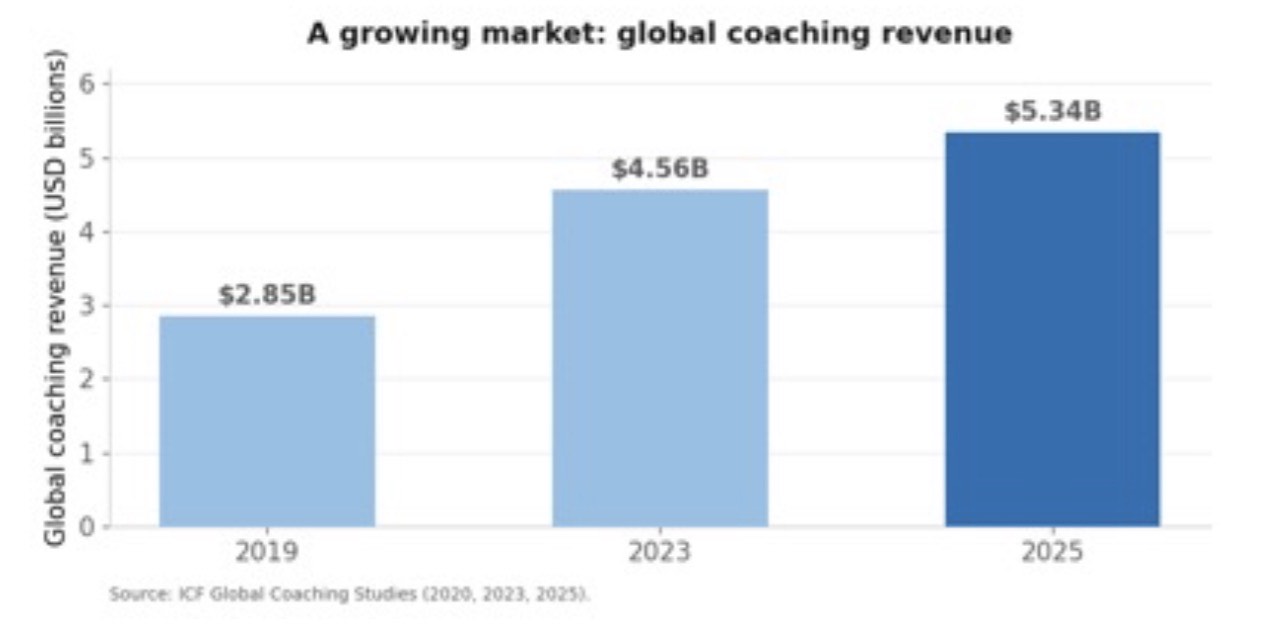
Global coaching revenue has grown roughly 60% since 2019 (ICF studies).
The main types of coaching, explained
Here’s what each of the most common types of coaching actually involves.
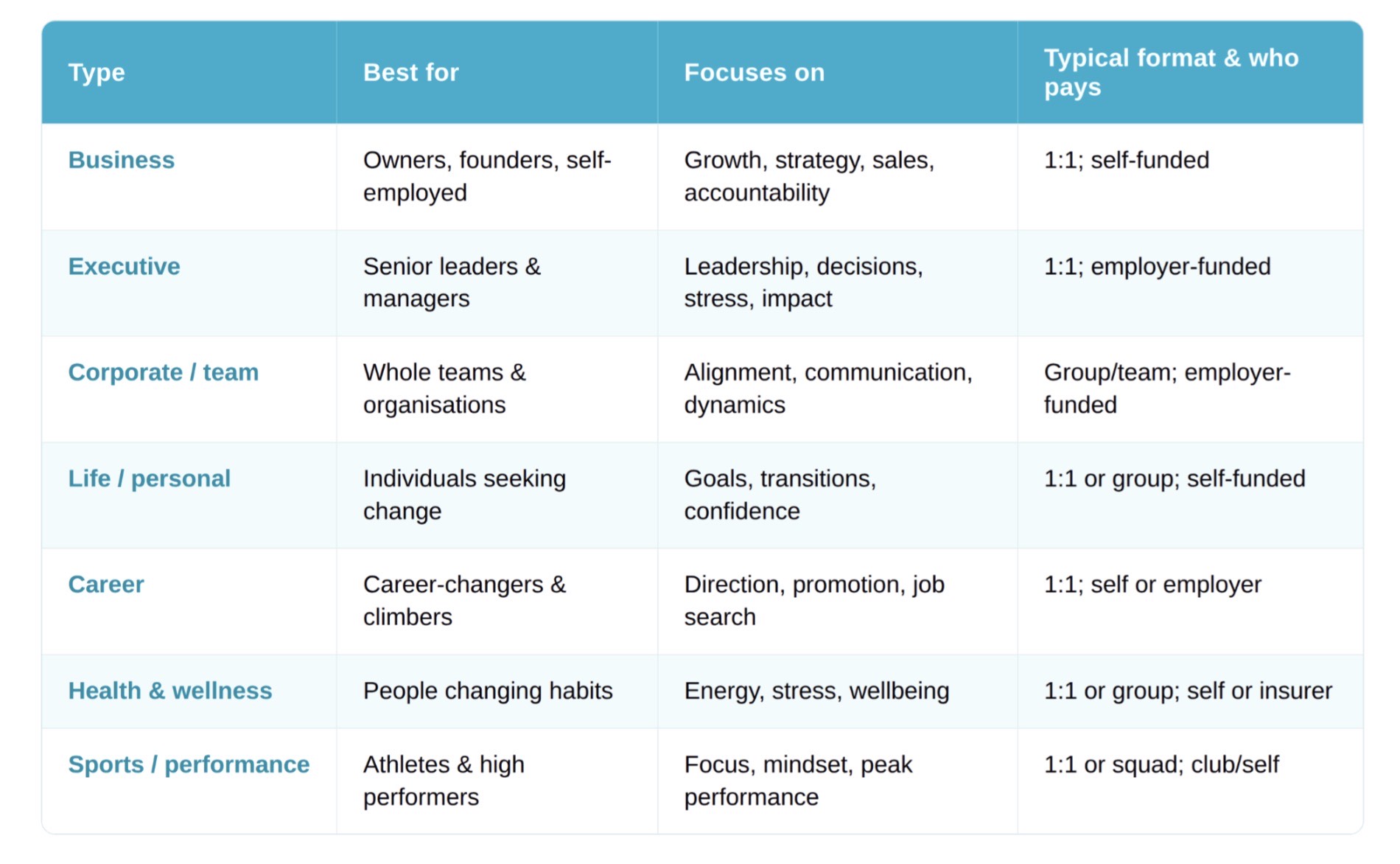
Business coaching
Business coaching helps owners, founders and self-employed professionals grow, stabilise or restructure a business. The focus is practical and commercial — strategy, systems, sales, cash flow and accountability. Demand is strong: among coaches with 10+ years’ experience, 80% specialise in business coaching.
Executive coaching
Executive coaching supports senior leaders to perform better in their role. It’s the highest-budget segment, usually employer-funded, and often folded into leadership-development programs. In one survey, 55% of executives said coaching helped them better manage workplace stress (Forbes, 2024).
Corporate & team coaching
Corporate and team coaching develops a whole group rather than one person. Where individual coaching can’t fix a collective problem, team coaching works on communication, alignment and group dynamics — often alongside one-on-one coaching for the team’s leader.
Life (personal) coaching
Life coaching helps individuals set and reach personal goals, navigate transitions and build confidence and clarity. It has the broadest client base of any type; the most-named topics consumers bring are personal growth, relationships and life transitions. If you’re weighing this path, see our guide on how to become a life coach in Australia.
Career coaching
Career coaching helps people change direction, get promoted or navigate the job market. Demand has risen with career pivots and remote-work shifts, and it overlaps with executive coaching at the senior end.
Health & wellness coaching
Health and wellness coaching supports behaviour change around energy, habits, stress and wellbeing. It’s one of the fastest-growing niches, buoyed by workplace wellbeing programs and preventative-health interest.
Sports & performance coaching
Sports and performance coaching raises performance under pressure — and, historically, it’s where modern coaching began. More on that story below.
Coaching types compared at a glance
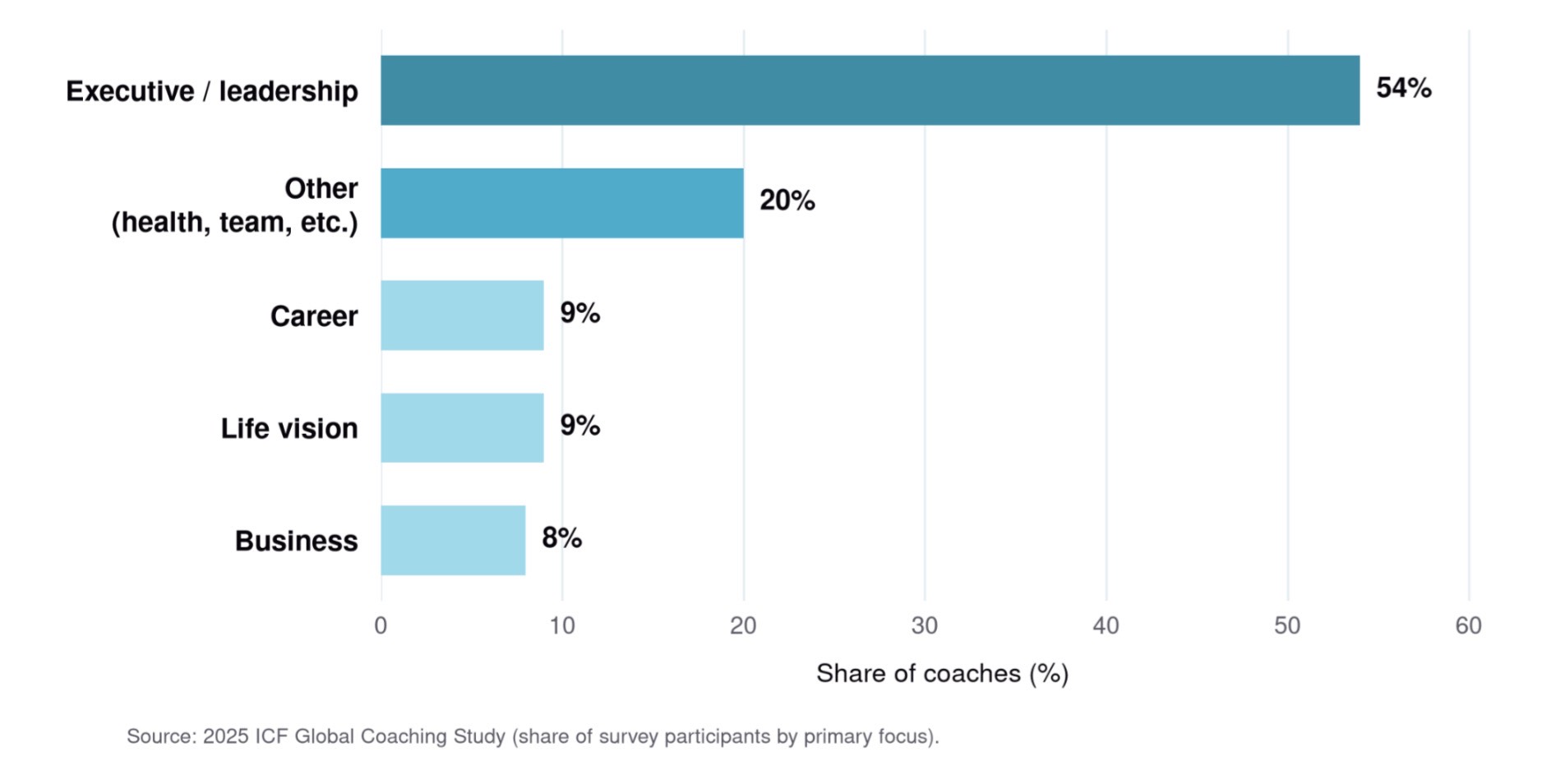
Over half of professional coaches specialise in executive or leadership coaching (ICF, 2025).
| Not sure which type is right for you? Talk it through with an IAP course advisor on 1300 915 497, or download the free course brochure to compare pathways. |
One-on-one vs group vs team coaching: which format?
The format matters as much as the type. Choose one-on-one coaching when the goal is deep, personal and confidential; choose group or team coaching when the unit that needs to change is a group. Here’s how they compare:
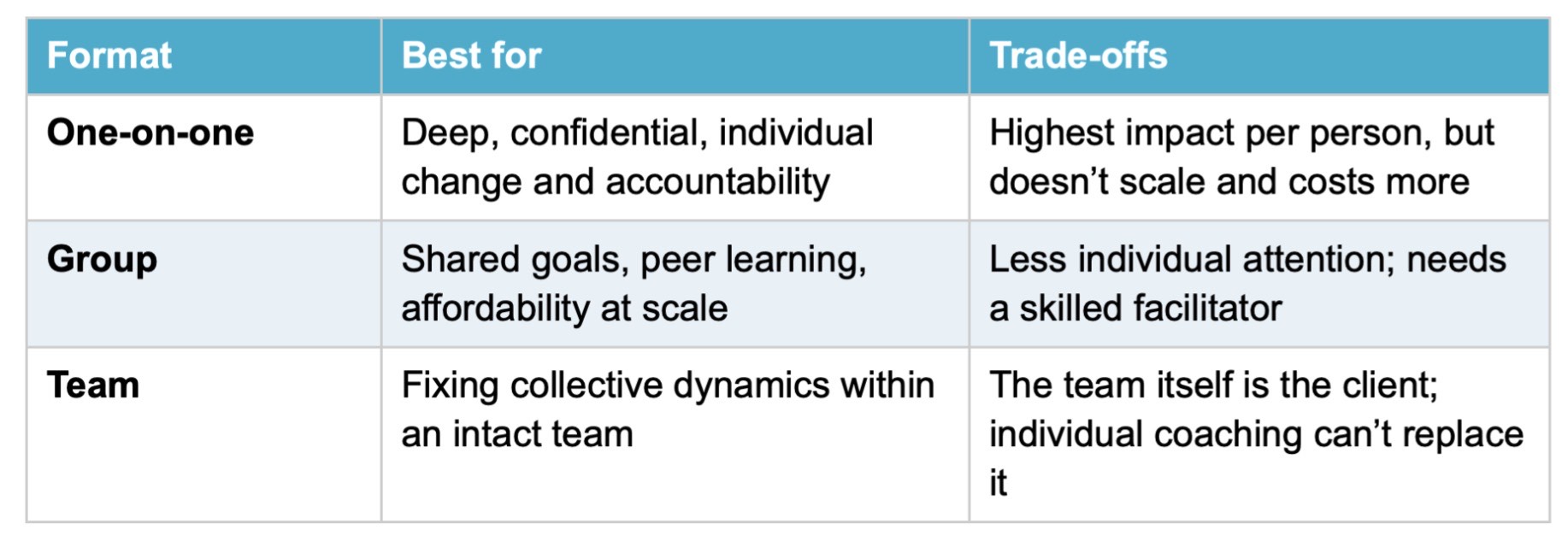
| Format | Best for | Trade-offs |
| One-on-one | Deep, confidential, individual change and accountability | Highest impact per person, but doesn’t scale and costs more |
| Group | Shared goals, peer learning, affordability at scale | Less individual attention; needs a skilled facilitator |
| Team | Fixing collective dynamics within an intact team | The team itself is the client; individual coaching can’t replace it |
Pro tip: the most common corporate setup pairs one-on-one executive coaching for a leader with team coaching for the group they lead — so the individual shift is reinforced where it has to land.
Where coaching came from: the sports connection
Here’s a fact most “types of coaching” guides miss: business and life coaching grew directly out of sports coaching. In 1974, Harvard tennis captain Timothy Gallwey published The Inner Game of Tennis, arguing that a coach’s instructions often got in the way of a player’s natural learning — and that performance improved when the coach helped the player simply see clearly and trust themselves.
British racing driver Sir John Whitmore trained with Gallwey, brought the Inner Game to Britain around 1981, and — with Graham Alexander and Alan Fine — turned those tennis-court insights into the GROW model (Goal, Reality, Options, Will), still one of the world’s most-used business coaching frameworks. They even chose the everyday word “coaching” deliberately, to describe the approach more broadly than “the Inner Game.” So when a coach asks questions instead of giving orders, that non-directive style traces straight back to the sports field.
Which type of coach do you need?
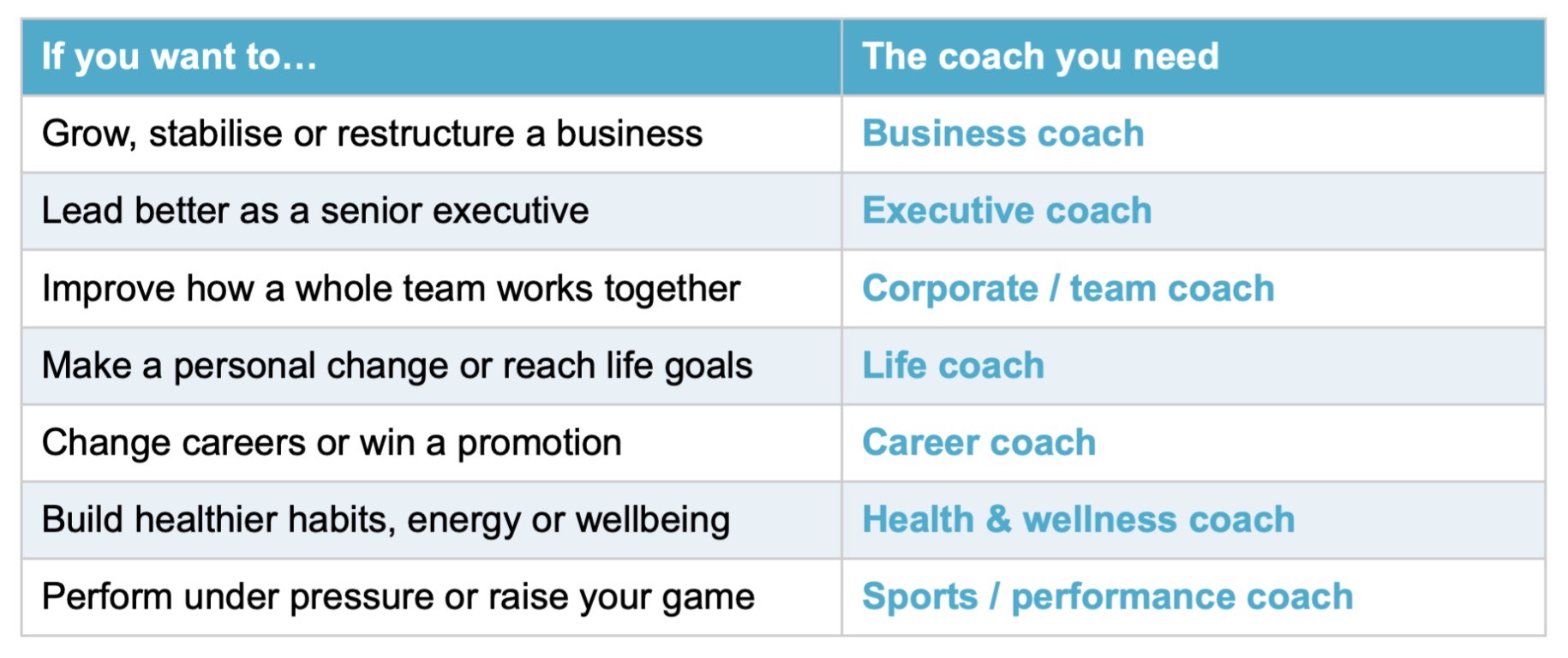
The quickest way to choose is to start from your goal, not the label. Match what you want to change to the type of coach who specialises in it:
Thinking of becoming a coach rather than hiring one? The same core skills underpin every type — which is why many coaches train broadly first, then specialise. If you’re also weighing how technology fits in, see our take on whether AI will replace coaches.
Why so many coaches look at the ICF credential pathway
Whatever type of coaching you choose, one question keeps coming up: is an ICF credential worth it? People look at the pathway from the International Coaching Federation (ICF) because, in an otherwise unregulated industry, it’s the closest thing coaching has to a global standard — a way to prove quality to clients and employers rather than simply claim it. If you’re thinking about training, here’s what the ICF pathway actually means for you:
• Higher earning power. ICF-credentialed coaches charge a median 84% more per session than non-credentialed coaches ($272 vs $148, ICF 2024).
• Instant credibility. When anyone can legally call themselves a coach, a recognised credential is the trust signal that sets you apart.
• Access to corporate and executive work. Many employers and procurement teams require ICF — unlocking the best-paid, most stable segment, where more than half of clients are employer-sponsored.
• Global portability. ICF credentials are recognised in 127 countries, so you can coach internationally or relocate without requalifying.
• A clear career ladder. Three levels — ACC, PCC and MCC — give you a structured path to raise your rates and reputation over time.
• Proven competence, not just attendance. Assessed coaching hours, mentor coaching, a recorded-session review and an exam mean the letters actually stand for something.
• Client trust and preference. 85% of clients say they value a credentialed coach, and 73% now say they expect one.
• Ethical protection. A shared code of ethics and standards protects your clients — and your reputation along with them.
For a full step-by-step on the levels, hours and costs, see our guide on how to become a life coach in Australia.
The bottom line
The many types of coaching — business, executive, corporate, life, career, health and sports — all share the same DNA: helping people find their own answers and act on them. Choosing well is simply a matter of matching the coach’s specialty to your goal and picking the right format, whether that’s one-on-one depth or the shared momentum of a group. Get that match right, and coaching becomes one of the highest-return investments you can make in a person, a team or a career.
Ready to train as a coach?
IAP’s NLP & Coaching training builds the human skills that sit at the heart of every type of coaching, with a pathway toward internationally recognised credentials. Call 1300 915 497 to speak with an advisor, or download the free course brochure to see outlines, dates and payment plans.
Frequently asked questions
What are the main types of coaching?
The main types are business, executive, corporate/team, life (personal), career, health and wellness, and sports/performance coaching. They differ by who the client is and what they want to change, but all use a structured, goal-focused, non-directive approach.
What’s the difference between business and executive coaching?
Business coaching helps owners and founders grow or restructure a business (strategy, sales, systems). Executive coaching helps senior leaders perform better in their role (leadership, decisions, stress) and is usually employer-funded.
What’s the difference between a life coach and a business coach?
A life coach helps an individual with personal goals, transitions and confidence. A business coach helps a business owner with commercial goals like growth, sales and accountability. The skills overlap; the focus and client differ.
Is one-on-one or group coaching better?
Neither is universally better. One-on-one coaching offers deeper, confidential, individual change; group and team coaching offer peer learning, affordability and the ability to shift a whole group. The right choice depends on whether the unit of change is a person or a group.
What type of coach do I need?
Start from your goal. Growing a business → business coach; leading better as an executive → executive coach; improving a team → team coach; personal goals → life coach; career change → career coach; habits and wellbeing → health coach; performance under pressure → performance coach.
Tags: types of coaching · business coaching · executive coaching · life coaching · sports coaching · corporate coaching · one-on-one vs group coaching
Sources: ICF Global Coaching Study 2025 and earlier editions; Forbes (2024); industry market analyses 2025–2026; coaching history per Gallwey, The Inner Game of Tennis (1974) and Whitmore, Coaching for Performance. Market-size figures are global and indicative; verify against the latest ICF Australasia data before publishing.